While domestic issues dominate the election campaigns for Polish president and parliament, the candidates’ stand on foreign policy might just pick them up a few votes, too.
As the German election results came in on Sunday night, many here – including me - were scratching their heads with disbelief: how can an electorate connive to produce a scenario where no side wins an election? After all, German politics is not supposed to resemble a cricket match.
The commentators tried to explain the possible future coalition options: a ‘traffic light’ coalition between Gerhard Schroeder' red Social Democrats, plus Joschka Fischer’s Greens plus the yellow Liberal Democrats; or would it be the red, red, green coalition of the Social Democrats, the Greens and the ex-communist left? Or maybe it would be the worst possible result of a Grand Coalition of leftist red Social Democrats and rightist black Christian Democrats?
A confusing situation for everybody, but just imagine what it must be like to a German who is colorblind?
Before Angela Merkel managed to somehow snatch defeat from the jaws of certain victory, it was expected, and hoped by most in Poland, that her Christian Democrats would be the winners. But the leader of the Christian Democrats has apparently had Personality By-Pass surgery and was no match for the tub-thumping charisma of the incumbent Chancellor, Gerhard Schroeder.
But would foreign policy be any easier between Poland and Germany if she had of held on to her lead in the opinion polls in the run up to polling day?
It is in Poland’s interest – and just about everyone else’s in Europe – to have a dynamic German economy. But sadly, the German economy seems as stodgy at the moment as a Black Forest Gateau.
Chancellor Schroeder’s limited reforms to the inflexible German workforce, and the minefield that is the German tax system, are seen to be too little, too late. Angie Merkel, on the other hand, seemed to be serious about serious reforms.
Poland is all set to vote in a rightwing coalition of their own on September 25, and a similarly right leaning government in Berlin might have made things a lot easier, foreign policy wise.
Poles are also not too happy with the German Chancellor at the moment because of a deal he has done with President Putin – behind Warsaw’s back say Poles – for a gas pipeline to be built connecting Russia with Germany, and by-passing Poland. This country is dependant on Russia for much of its gas supplies. The fear is that Moscow could use the pipeline to divert gas away from Poland in times of diplomatic crisis between Warsaw and Moscow.
And that diplomatic crisis has seemed quite close this year. Arguments over Russia’s refusal to take the blame for atrocities during the Second World War, and their inability to comprehend that Poles do not regard the Soviet occupation of Poland after the war as a ’liberation’, have soured relations considerably.
So issues such as Russian gas could become explosive very quickly. And many Poles blame Chancellor Schroeder for the gas pipeline deal, and think that Poland should have been consulted before anything was agreed.
In retaliation, the parties expected to be in the Sejm, the Polish parliament, after the election here in a couple of weeks, have said that they will not be backing Germany’s bid to get a permanent seat on the UN Security Council.
But if Merkel does emerge after the long and tortuous negotiations currently going on in the German capital, then she will not be given an unconditionally warm reception in Warsaw either.
They must be joking!
After the end of WWII, millions of ethnic Germans were forced to leave Silesia in the southwest and Pomeraria in the north of Poland, and other regions in eastern Europe. These Germans, it was argued, supported the Nazis during the war, and, as a result, eight million of them ended up in Germany and about half a million in Austria.
Since Poland joined the EU last May, Merkel’s Christian Democrats have been leading a campaign to put pressure on Poland to apologize to the expelled Germans and offer them some compensation. There has even been some talk among German conservatives over the years for a renegotiation of the borders between Germany, Poland and the Czech Republic.
It goes without saying that this has not gone down at all well in Poland, a country that sees itself as a victim of Nazi aggression, and a nation that has got nothing to apologize to Germany for at all.
So scraps between Germany and Poland seem to be a dead cert whichever parties emerge from what one commentator has called the German party political promiscuous gangbang that is currently going on at the moment in Berlin.
But Polish politician’s attitude to Germany might just be a bit of an election pose – see how all the acrimony might just fly out the window as Poland tries to get German support for 80 billion euros worth of subsidies from the EU in the 2008 – 2013 budget, presently in negotiation.
One thing you can be sure of though: the result of the Polish election will not be as obscure as German one was last Sunday. We are sure of a government, probably between the right-wingers Civic Platform and the Law and Justice party.
And don’t worry – this will not be a red, red green collation, or a traffic light collation, or even a chameleon coalition: both parties are using the political color of the moment – orange. So get ready for Poland’s freshly squeezed, double orange coalition.
And even a colorblind German could get his teeth around that one.
Tuesday, September 20, 2005
Not so quiet on the western front

Friday, September 16, 2005
The Third Way: no, not that one

A group from Belarus are using the old Blair/Clinton tag to activate society and form a coherent political opposition to Lukashenko’s authoritarian regime. Shame, then, that they have decided to call it the ‘Third Way’.
The group was launched in August 2004, and their web site claims to have had ten thousand visitors since. They join what is now a myriad of groups trying to organize a coherent opposition to the regime of Alexander Lukashenko, which Condaleeza Rice and others have called, ‘the last dictatorship in Europe’.
This particular ‘Third Way’ says that they are against: violence, revolutions, centralized education and distribution, and, of course, dictatorships. They are for: equal rights for all, transparency in government, problem solving through negotiations and evolution of society.
None of which sounds particularly original, so how is this a ‘Third Way’?
The group says that: “We believe that it is not possible to succeed in transformation of society by simply reproducing the past experience of the country (the first way) or imitating the way of the development of other countries (the second way).
This particular ‘third way’ is not a set of political programs, but, “we prefer to consider and compare various models of state structure, scrutinize different aspects of society development, aspiring to find ways for the Belarusian state to develop to — the third way that will lead it to prosperity.”
We can only wish them the best of luck. The CPJ, a press freedom organization, thinks that the last elections in Belarus in 2004 were deeply flawed:
“President Aleksander Lukashenko strangled the country's independent and opposition media in the months before [the] October elections that returned his supporters to Parliament. The obedient state media flooded the capital, Minsk, and the countryside with pro-Lukashenko propaganda, vilifying opposition leaders and urging voters to support the president or face Western domination and political instability.”
The Lukashenko government has also been harassing the 300.000 Polish minority in Belarus, which he thinks are stooges of malevolent forces trying to wrestle the country from his greasy little hands. And he is right, of course.
Third Way to where?
So good luck to Belarus’ ‘Third Way’. But did they have to pick such a silly name?
The ‘Third Way’ has already been used many times as a way to define new political movements, and it has always failed to distinguish itself from first and second ways.
In Poland during the times of Solidarnosc, the third way was an attempt by some in the Union to find a way between capitalism and communism.
And Tony Blair set out his vision of a third way when he was dismantling the old Labour Party and forging New Labour.
The theoretical gurus of the ‘third way’, are sociologist, Anthony Giddens, and those working at the Demos think-tank. But getting them to actually define what this is, is another matter. Here’s an email in 1998 from Tony Blair to the NEXUS magazine.
“Politics is changing and I believe the left-of-centre has the opportunity, and a special responsibility, to develop the ideas that will shape the debates of the new century. Clear in our values, we must combine analytical insight into the way the world is changing, with genuine imagination about how to put our values into effect.”
Note that he is not actually saying what these ‘new values’ are.
At that time our Tony was very close to Bill Clinton. What does Bill think the third way is?
“We have called our approach “the Third Way”– with a government that is more active, more effective, less expensive; one that can bring us together and move us forward, not drive us apart and set us back.”
Er…right. Perhaps the American Third Way web site can help us discover what this actually is. It says:
“Third Way is engaging a broad range of leading experts to develop policy options that respond to the contemporary economic challenges facing the American middle class, as well as themes that communicate progressive economic values and priorities in ways that will resonate with middle class workers and their families.”
So maybe the ‘Third Way’ is not a set of values and ideology at all, but, like Belarus’ ‘Third Way’, an attempt to, “consider and compare various models of state structure, scrutinize different aspects of society development”?
What Clinton and Blair meant by this alternative way was actually keeping the economic transformations of Thatcher and Regan to keep the right happy, but add on a bit of touchy-feely stuff about ‘empowerment’, ‘inclusiveness’ and ‘accessibility’ for the get the liberals on side.
But in reality the ‘project’ never got much further than the think tanks. Ideologies such as the old socialism, etc, came from social movements in society. The problem for “Third Wayists’ - be they from the UK, US or Belarus - is that these ideas are not coming organically from society, but from university libraries - or in the case of Tony Blair, from a notepad on his knee while sitting in his bedroom.(where he re-wrote the Labour Party constitution back in the mid-nineties).
So, please Belarus – don’t go down the Third Way: it’s a way to nowhere.
Wednesday, September 14, 2005
Out for the count

Former PM and foreign secretary, Wlodzimirz Cimoszewicz, has withdrawn from the race for the presidential palace.
At a press conference this morning Cimo said that he was throwing in the towel due to 'black propaganda' by his opponents: 'I am pulling out in protest at a dirty campaign of defamation of which my family and I have been victims,.. I cannot urge my supporters to back any other candidate in the presidential race, as none of those running deserves their vote,' he said.
When he announced his candidature last month he went straight to the top of the opinion polls. But after he was accused of withholding information about personal assets in a statement made a couple of years ago, his ratings plummeted.
This leaves only two front runners for head of state – right wingers Donald Tusk - the middle class favourite - and Lech Kaczynski, Mayor of Warsaw.
How those who would have voted for him will react to his resignation is unclear. Some think that the majority of votes will go to candidates who believe in more state intervention in the economy – namely Kaczynski, or even leader of the farmer’s trade union Samoobrona, Andrzej Lepper.
Tuesday, September 13, 2005
Polish plumber revisited
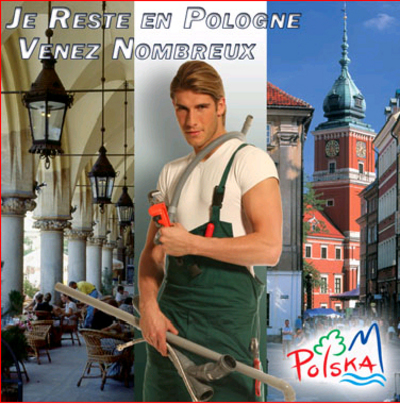
An article I wrote turns up in some weird and wonderful places.
The term the 'Polish plumber' was first used by French politician Philippe de Villiers (although this is disputed - see comment) to explain the fear that French voters felt about an expanded EU during the time of the referenda in May. I wrote an article about it called Polish plumber puts a spanner in the works.
Since then it has turned up in all sorts of places, such as freerepublic.com etc, UK Ratifiers for Democracy and even a blog with the title fuckfrance.com!
So it is with delight then that I learn that a political article such as that one about the EU has turned up in...Daily Plumbling News - a blog for plumbers!!!
Friday, September 09, 2005
The Chernobyl myth revisited

The United Nations has confirmed that fears of hundreds of thousands dead and dieing from the Chernobyl disaster in 1986 are unfounded.
As I pointed out in an article I wrote last January (see The solution for a cleaner environment: Go nuclear!) the reporting of the meltdown of the old No. 3 reactor in rural Ukraine nearly two decades ago continues to exaggerate what really happened there.
The United Nations report states that 56 emergency workers lost their lives in Chernobyl that day. Many more have gone on to develop cancers directly as a result of the accident. But these are all from the emergency services, not, as has been reported over and over again, from those living in, around, and far away from the reactor. Radiation did travel west and north of the town into Poland and Belarus, but nobody has died as a result.
But this has not stopped reporters from reputable organizations from repeating what has become another doomsday myth. For instance, the BBC in December 2000, when the reactor was finally shut down for good, stated that:
“Thirty-one people, mostly firemen, were killed immediately after the explosion, and several thousand more - those involved in the clean-up and children - have since died from radiation-related illnesses. Ukraine says the health of millions of its people have been affected by the disaster.” (see Chernobyl shut down for good)
The new UN report merely restates what an earlier report by the same organization (see United Nations Scientific Committee on the Effects of Atomic Radiation) stated in 2000. The deaths that occurred were to emergency staff and not the local population, and that many less have died and will die than was originally reported.
Well, they would, wouldn't they?
I was at a dinner party shortly after I wrote my original story nine months ago, and was talking about the Chernobyl myth. I was asked how I knew all this, and I said that I just read a report by the UN and talked to one of the scientists that worked on the report, Zbigniew Jaworowski. The disbelieving response was typical: “Well, the UN would say that, wouldn’t they. I bet they have a lot to hide.”
When I asked my dinner party friend what he thought the UN had to hide by ‘covering up’ what happened in the Ukraine many years ago, he couldn’t answer. Incapable of having a discussion about nuclear energy, he fell back on that old, limp tactic of ‘Well, they would say that, wouldn’t they.”
And of course you can’t discuss something with somebody who sees cover-ups and conspiracies everywhere – even though they have no evidence to back up the claims. Looking for motives for saying x has become more important than looking at, and confronting what x actually means. Consequently, nothing is debatable. Nothing can be argued to be right, or wrong. We live in a world where people (mostly scientists and politicians) only think and believe things because of some ulterior motive.
So debating politics (or anyting else for that matter) has become impossible with these sorts of people. Debating nuclear energy is now impossible with the techno-luddite and the NYMBY.
And this is a shame at a time when the EU, and the Kyoto agreement is telling us to cut our reliance on fossil fuels.
Wednesday, September 07, 2005
Presidential homophobe gets taken to human rights court

Lech Kaczynski, second in the opinion polls at the moment for the race for the presidential palace, is being taken to court for denying Polish gays rights to free assembly.
Kaczynski, who is also the mayor of Warsaw, refused permission for a gay and lesbian pride march through the center of Warsaw this May. This is the second year in the row that Kaczka has let his bigotry get in the way of his duty to citizens of the Polish capital.
Outraged, gays, lesbians and human rights campaigners went ahead and had the march anyway.
Now, gay and lesbian associations here have lodged a complaint with the Human Rights Tribunal in the Hague accusing the mayor of civil rights abuses.
The European declaration on human rights protects the civil rights of gays and lesbians.
Donald Tusk – fighting for the right to snort

If opinion polls are to be believed, presidential candidate, Donald Tusk, could well be the first member of an ethnic minority – and snuff taker – ever to set up residence in the Polish presidential palace.
When the government banned the sniffing of snuff in the nineteen nineties, Kashubians – the Slavic ethnic minority from the Pomeranian region in northwest Poland – were up in arms. Putting powdered tobacco up the nose has been an integral part of their culture since the seventeenth century.
At the head of the campaign for the right to sniff snuff was leader of Civic Platform, Donald Tusk. “If snuff is banned then we might as well ban smoking cigarettes,” he says. And in a country where millions puff, cough and wheeze their way through packets of ciggies everyday, this was not a political option.
So, in 1999, an amendment to the law on the protection against the effects of tobacco products re-legalized snuff taking. Thousands breathed (and sniffed) a sigh of relief.
Donald Tusk has been a tireless campaigner for the linguistic and cultural rights of Kashubians since he was at university. “The way to keeping the culture alive,” he says,” is for the authorities to give full recognition to Kashubian as a distinctive language, and not a dialect.”
He has published an elementary school textbook in the language, and a children’s dictionary. Because of his efforts, the language is now taught at schools in the region as a second language. “These days the language is really catching on; cultured Kashubs even like to show off by speaking it.”
It’s generally thought that there are around 300,000 Kashubs in Poland. However, in the last census in 2003, only 5,000 identified themselves as such, though 50,000 said that they could speak the language.
“The Polish and Kashubian identities live closely together. To be a Kashubian means to be Polish. Kashubs don’t like to think of themselves as a minority. They don’t even like the word ‘minority’. Where they live, they are the majority.”
The Kashubian region was incorporated into Poland in 1454. The area was invaded by the Teutonic Knights, the Swedes, the Brandenburgs and the Prussians. But as the soil in the region was not particularly fertile, and fishing unpredictable, Kashubians often suffered great poverty. Between 1859 and 1898 many thousands emigrated to Canada and the United States in search of a better living. Consequently, the Kashubian identity faded away.
Kashubs fight back
To make matters worse, being a member of an ethnic minority was not encouraged in communist Poland.
As a result, Tusk, born in Gdansk in 1957, was 21 years old before he knew he was a Kashubian.
“I was stunned when a colleague of mine at university told me of my ancestry. My parents, grandparents and great grandparents were born in Gdansk. The city was a real melting pot of German and Polish cultures. Kashubians who lived there quickly forgot their roots. My parents were totally unaware of their ethnic identity.“
Worse, belonging to that ethnic group had negative connotation. “Only a couple decades ago, the label ‘Kashubian’ was a term of abuse; it implied that you were a bit ‘simple’.
But the realization of his true ethnic identity quickly produced positive results. “When I was at university, one of my professors could have kicked me out of college because of bad grades. But, as he was a Kashubian too, he didn’t. This act of solidarity really meant something to me.”
Kashubian crafts specialize in embroidery, ceramics, painting on glass and amber jewelry. One of the crafts and traditions characteristic of the region is making snuff pots out of cow’s horn, made in the shape of a cone, sometimes with a top curved into the shape of animals or birds.
Don’t be surprised when in the area to be offered snuff. You might hear the phrase ‘Chceme le so zazec’ – Let’s take snuff.
Snuff sniffing is a habit usually associated with males and maleness. Refusing to take some between the crook of your thumb and forefinger is considered bad manners. Kashubians take their snuff seriously, and it is a core part of their cultural identity. Hence Donald Tusk’s fight to legalize the practice.
Could it be, then, that Poland is about to elect its first Kashubian, and snuff snorter into the presidential palace? Certainly he’s assured of much of Kashubian vote.
A version of this article first appeared in the NWE
Monday, September 05, 2005
Polish politics: confused? You ought to be

With a general election only weeks away, and a presidential election early next month, you will often be hearing descriptions of the various political parties as either being right, left, liberal, moderate and so on. But these labels in Poland can be very confusing. (pictured: Andrzej Lepper, Samoobrona)
Take, for example, the leading political party in most of the opinion polls at the moment, Civic Platform. I have seen them variously described as liberal, centrist, center/right, rightist, and even neo-conservative.
The term ‘liberal’ is doubly confusing as it means different things on different sides of the Atlantic. In the United States ‘liberal’ is generally seen as being left of center. To an American right-winger, a liberal is a ‘pinko’ who believes in Big Government. During the McCarthy trials in the nineteen fifties a liberal was a communist (although we should remember that having a significant amount of facial hair in nineteen fifties made you a communist in America).
In Europe, however, a liberal means someone who believes that the government should stay out of most areas of public and private life. To ‘liberalize’ the economy means to roll back state intervention. A liberal in Europe can mean a right-winger who believes in small government.
But what does a ‘neo-conservative’ mean? Does this mean Civic Platform is Poland’s first party of neo-cons? Does this mean that Civic Platform share the foreign policy ideology of a Paul Wolfewitz and Donald Rumsfeld, for example (and are they planning to invade Belerus)? And if they do share this view of the world, then how does that make Civic Platform ‘moderate-centrists?
If you actually take look at Civic Platform’s manifesto it basically consist of liberal (in the European meaning of the term) economic policies – meaning increasing the rate of privatization, and a low, flat tax policy – an idea attractive in many ex-communist countries. But on social issues the ‘liberal’ Civic Platform is relatively conservative – they do not propose to ‘liberalize’ Poland’s very restrictive abortion laws, for instance.
Liberal, free market economics, plus social conservatism are actually policies associated with Margaret Thatcher in her prime in the nineteen eighties. And if you called Maggie Thatcher a centrist-moderate, or even a center-rightist in those days she would have given you a sharp crack over the head with her handbag. Thatcher was a radical right-winger. Period.
Civic Platform, in the Polish context, is often called center-rightist or moderates, but in any other context they would be thought of as simply rightwing.
Confused yet? Well, it gets worse.
Take what have been called the ‘far-right’ League of Polish Families. These are ‘christian nationalists’, with a nationalist pedigree that goes back to the nineteen thirties. Historian Norman Davies has described The League of Polish Families nationalist, forbears as ‘professional anti-Semites.’ So they do sound like typical far-rightists in their choice of prejudices.
But when the League of Polish Families was set up as a political party a few years ago I saw them labeled as ‘christian left’ – whatever that means. For sure, their policies are based on an interpretation of Polish social Catholicism, are isolationists – they hate the EU, for example, as they think that Poland will become inundated with social liberals (in both the American and European meaning), abortionists and gays and lesbians. They also want to restrict the amount of foreign capital in Poland.
So are they left, or right?
The Law and Justice party was set up by the Kaczynski twins, Lech and Jaroslaw. They have been described as ‘conservative’, ‘right wing’, or even, sometimes, ‘center/right’. They have promised to be tough on crime and criminals, even going as far as to bring back the death penalty. These types of anti-crime policies are usually associated with the political right. Economically – and here’s the twist - Law and Justice are, if anything, to the left of the so-called ‘centrist’ Civic Platform, but to the right of the so-called ‘christian leftists’, the League of Polish Families.
Agrarian populism
Another grouping you will hear of in the coming few weeks is Samoobrona – or SelfDefence, led by the political bullyboy, Andrzej Lepper. This was set up as a kind of farmer’s trade union, protesting against all sorts of things, from liberalization and increased competition from agriculture outside of Poland, to attacks on farming subsidies, etc. At a loss to where to put this lot’s political orientation, journalists have turned to the catchall label of populist.
Populism – which can be either left or rightwing - usually refers to a rhetorical style that appeals to the ‘common sense’ of the electorate and the average man or woman in the street. It asserts that the political elite is corrupt and self-serving and needs to be overthrown by people with ‘common sense’. It also usually incorporates a bit of racism or nationalism thrown in for good measure.
This does describe SelfDefence quite well, but populism is also a label that could be applied to many of the political parties in Poland.
Except, that is, to the Social Democratic Left – a party that was formed out of the old Polish communist party. Policy wise these are basically social democrats, but they are the ones who are being accused of being the self-serving corrupt elite by the populist parties. Law and Justice and League of Polish Families pledge to purge the ex-communists, not just from government, but from the civil service, many other quasi-governmental organizations, the secret service, and so on.
Consequently, in Poland, how far a political party can be described as ‘rightwing’ really comes down to how much they hate the ex-communists.
At a time when left and right are all but loosing their meaning in the west, in Poland, where these labels are quite new to the political scene, they are all but useless. Politics in ex-communist countries is peculiar to ex-communist countries. So using the terminology of left, right, etc, has little meaning outside of the country where the terms are being used.
But journalists will still be using them. And if you think that you are confused by Polish politics, spare a thought for the poor old Polish voter who will have to choose where to put their tick beside a name of a party, or individual, that could labeled as either liberal, centrist, rightists, moderate, neo-conservative, or all of them simultaneously.
And people wonder why turnout in Poland is so low!
A shortened version of this article can be found at the Radio Polonia web site
Thursday, August 25, 2005
Polish presidential election: Cimo in the doo-doo

The one time front-runner in the race for the Presidential Palace has plummeted in the polls due to either corruption, or a rightwing witch hunt (delete according to political preference).
When he declared that he was running for president in elections on October 7, Wlodzimirz Cimoszewicz, the candidate for the ex-communist SLD, leapt to the top of the opinion polls.
And then the corruption scandals began. Cimo has been accused of lying in a parliamentary statement of assets in 2001. The scandal may be settled by the end of this month, although the state prosecutor is looking into the matter.
Cimoszewicz was trying to present himself as the only member of the SLD government not to have been embroiled in political corruption scandals recently. His hands were clean.
And then details emerged which have called into question his record. Cimo says that document’s ‘proving’ his guilt are forged – and this is certainly very possibly true.
But whatever the result of the enquiry, it seems that his candidature is now doomed. His ratings have nose-dived in the polls, going from a clear first to a dismal joint second, or third, depending on which newspaper you read.
The new front-runner is Donald Tusk, from the thatcherite Civic Platform. But even he doesn’t seem particularly impressed with his, or the other candidates’, platforms and personalities.
In an interview with the Polityka weekly, Tusk said the race, "is not a campaign between two giants. Rather it is a struggle between five or six medium-weight candidates, none of whom crushes opponents with their personality or charisma".
And I presume he is including himself as one of the pigmies.
And they complain about low turnouts in Poland. If even the political class are not impressed by themselves, then how are the rest of expected to get interested?
Tuesday, August 23, 2005
Poland and Belarus – still Poles apart
The Belarusian president continues his harassment of Poles and journalists
The former head of the Union of Poles in Belarus, Tadeusz Gawin, has received a second, consecutive two-week jail sentence.
The current President of the Union of Poles, Agelica Borys, says she has now been called in to be interrogated by Lukashenko’s goons 41 times now.
Last week, another activist from the Polish minority in that very odd country, Weslaw Kewliak, received a similar sentence for meeting a leading Polish politician in Grodno, western Belarus, close to the Polish border.
What’s their crimes? Gawin is charged with beating up a cellmate, a charge he denies. Kewliak has been charged with trying to destabilize the Belarusian state.
Poland as a nation is being accused of trying to whip up revolution, in an attempt to topple Europe’s weirdest head of state – who Condaleeza Rice has called ‘Europe’s last dictator’ - Alexander Lukashenko.
Both countries have been expelling each other’s diplomats for a few weeks now in a row that will only get worse, before it gets any better.
In another development, the Belarusian government has closed down another independent newspaper, the Dan. In a statement, the authorities said the paper, “interrupted its commercial activities for six months and failed to explain the fact to tax officials.” The director of Danpress, Nikolai Markevich, said that this was complete bull: it was Lekashenko’s toady judges who forced the company to stop trading by stripping it of a legal address, which meant that it had to publish from Russia. Dan regularly publishes articles critical of Lukashenko.
Over the last two years the Belarusian authorities have closed over 20 independent newspapers.
Lukashenko – strangely for man who would not look out of place in a Keystone Cops movie - obviously has little sense of humour. Last week, Paval Marozau, one of the founders of a cartoon series which lampoons Lukashenko for his Stalinist style censorship and megalomania, said that security agents had questioned him and two others, accusing them of insulting the honor of the Belarusian president. Consequently, the Belarusian state is charging the artists with libel.
Give him the peace prize!
But Lukashenko is a fighter for human rights! No, really.
He was traveling through Minsk, the capital of his small little empire, last year when he noticed that there were too many models staring out of billboards that did not look like Belarussians. So he had the wizard wheeze of creating a law that compels advertisers to only use Belarusian models in their ads. This on the grounds that the law will create more work for them at home and stop them going abroad for work, where they could be used as sex slaves and be trafficked.
And the OSCE, EU, US - and, who knows, even Robert Mugabe - all agree that the president of Belarus has no respect for human rights!
The beatroot thinks that this man is not the last dictator of Europe. He’s more like Europe’s next Nelson Mandela!
Saturday, August 20, 2005
Freerepublic.com and the beatroot
Cindy Sheehan, the bereaved, anti-war mother who is camped outside George Bush’s holiday ranch in Texas at the moment, is being harangued by counter protesters from the rightwing, freerepublic.com. The beatroot has had encounters with this lot, too.
Freerepublic.com is an American newsgroup which uploads articles from sites from around the world and then members – there are at least 50,000, known as freepies – discuss, debate, or abuse. And they regularly take my stuff from the radio station web site I work for.
For instance, an article I wrote about the Polish role in the French and Dutch EU referenda this summer, Polish plumber puts a spanner in the works, drew these comments from the freepies.
“The Poles have saved Europe... again. Who would have thought it, 25 years ago?” Or, “Well a Polish electrician brought down the Soviet Empire.”
Harmless stuff. But one comment nearly made the beatroot choke on his beetroot soup.
“Wow, I thought I was reading Mark Steyn for a moment. Nice article!”
Hang on there, freepies! Mark Steyn is the author of occasionally entertaining rightwing rants in the UK Daily Telegraph, and all over the place in the US. But he has the usual base prejudices of the conservative which make the beatroot barf – homophobia, etc.
So being compared to him is a dubious compliment. And there isn’t anything rightwing about that article, either.
(For the record, the beatroot is not right or left wing. That old duality has bitten the dust. These days the real duality is between authoritarianism and libertarianism. And both the Bush and Blair governments show the same liking for creeping authoritarianism.)
The freepies: who are these guys?
Freerepublic.com members are a mixed bunch, representing all the nuances of the US rightwing. Freepies are mainly made up of:
Neocons: people who think like Rumsfelt, et al, (and Christopher Hitchins). They favour taking the American dream to the world, and liberating nations from tyranny by bombing and invading them.
Paleo-conservatives: Pat Buchanan types. Protectionist, isolationist, religious, with just a whiff of anti-Semitism.
Liberationist conservatives: Charlton Heston types. Small state conservatives, anti-gun control (even for British cops in London!).
Meanwhile, back at the ranch – Bush’s ranch – Cindy Sheehan sits and waits for George to come and talk to her about why her son died in Iraq (something about a war going on down there, Cindy).
And the freepies hate her guts.
Freerepublic.com’s habit of uploading whole articles from other web sites has got them into trouble on the grounds that this is not ‘fair use’ of copyrighted material. Last year they were successfully sued by both the New York Times and Washington Post.
Maybe the beatroot should get a good lawyer?
Friday, August 19, 2005
Religious hate is alive and well and living in Poland
Father Henryk Jankowski - better known to people with longer memories as the “solidarity priest’ and one of the heroes of the Solidarity revolution – is, in reality, just an unreconstructed bigot. Period.
As Poland celebrates 25 years since the birth of Solidarnosc – the first free trade union in the communist bloc – all eyes are on Gdansk, the city where the union was conceived.
One of the key concessions that Lech Welesa and others won from the communist authorities in August 1980 was the construction at the Lenin Shipyard of a monument to workers who were killed there in 1970, as they protested against price rises. The monument was blessed by Father Jankowski, who became known as the 'Solidarity priest'. What a hero!
Little did we know that this guy is quite a nasty piece of work. He was then, and he still is now.
At a rally marking the Solidarity Revolution this August, Jankowski went into a tirade against ‘Jewish bankers’, and other foreigners who are a danger to present day Poland.
Foaming at the mouth, our cuddly Polish priest said: "The recommendations of Brussels commissars and Washington economic gurus are threatening Poland's identity and sovereignty. We are filled with horror when laws are imposed upon us that are thought up by anti-Catholic Masons, Jewish bankers and hell-born atheistic socialists."
He's made these sorts of remarks before: many times. In 1997, the Church banned him from preaching for a year after he stated that Jews had no place in the Polish government. In 2004, he reacted to allegations of involvement in the sexual abuse of children by alleging a "Judeo-communist plot".
The thing is: what should we do with idiots like Jankowski? Should we ban them? Should we boil them in oil? Or should we let them spout off their odious rubbish and then expose them for what they are – complete fools?
I’m for the latter. Banning hate will not make it go away. But getting it out in the open is the way to belittle it, and defeat it.
Thursday, August 11, 2005
Solidarity, 25 years after
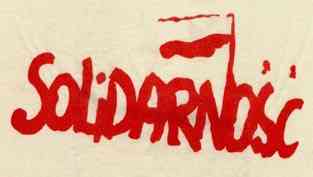
Lots of celebrations in Poland going on at the moment remembering the birth of the Solidarity trade union.
Standing by the gates of what was then called the Lenin Shipyard, Lech Welasa - the electrician who was sacked from the yard years before - triumphantly announced on that day, 1980: “We now have free and independent trade unions.”
Walesa had just signed the Gdansk Agreement with a massive pen with the face of John Paul II depicted on it. The agreement meant that, for the first time anywhere in the eastern bloc, communist authorities had formally agreed to free trade unions and freedom of speech. Alongside these concessions, Prime Minister, Mieczysław Jagielski, also guaranteed the release of all political prisoners.
Polish Euro-deputy for Civic Platform, Jacek Saryusz-Wolski, remembers the day well. He told the beatroot: “I was a Solidarity activist in Lodz at the time, setting up an inter-departmental, regional chapter of the union there. I remember feeling great joy at the news. It was simply unbelievable.”
August 31 will now be a national holiday in Poland – although this year there will be no day off work as it falls on a Sunday. Historian Wojciech Roszkowski says, “As a symbol it’s a good idea to promote the idea of solidarity in Polish society and abroad.”
Speaker of the House and presidential candidate of the ex-communist SLD, Wlodzimirz Cimoszewicz told Radio Polonia that the lessons of 25 years ago should not be forgotten. “It is in the interest of Poland and historical truth to remind the world what happened then. It was the first element in a chain of events in central Europe that had geo-political consequences which affected a whole continent.”
American historian, David Morgan thinks that what happened in Gdansk in 1980 will not be easily forgotten by anyone. “The more I study the Solidarity movement the more in awe of it I become. When you look at its discipline and its liberal goals, it’s an inspiration.”
Dancing cranes
Twenty-five years later, a whole host of events are scheduled to mark the occasion. Jean Michel Jarre will be the star of a sell-out concert at the Gdansk shipyard on August 26. He will be playing his old hits like Oxygen, of course, but has also composed a piece especially for the occasion. Lasers will blast across the night sky and the industrial cranes that are so characteristic of the yard will ‘dance’ in front of assorted heads of state, other VIPs, and 125.000 people in the audience. The show, which will cost around 1.5 million Euros to put on, will be shown live on TV and streamed on the Internet.
And in Warsaw on August 29, at Plac Teatralna in front of the National Theatre, there will be a concert featuring the songs of the period. Artists from Poland and abroad will sing the songs of the ‘Bard of Solidarity’, Jacek Kaczmarek, and many others. Huge screens in the square will show events commemorating the birth of Solidarity in Poland and around the world,
Apart from concerts, some have found other ways to mark the day. Many teenagers in Poland are not aware that Solidarity helped changed, not only Polish society, but also had an influence far beyond the nation’s borders. To fill the vacuum in these kids’ heads, Gdansk artist, Maciej Jaszynski has come up with the idea of presenting the historical events of 1980 in the form of a comic strip. Maciej says the idea was inspired by something a teacher said to him: “Teachers say that students absorb facts if they are presented in a simple and direct way. I think the Solidarity comic book does this.”
Read on:
www.solidarnosc.gov.pl describes, in six languages, the coarse of events that led to Lech Welesa signing the agreements.
This article originally appeared in the New Warsaw Express
Woman sees face of Jesus in a Polish dumpling
Donna Lee, from Ohio, US, says the image appeared in a pierogi — a Polish dumpling — as she was cooking it for Easter dinner at her home near Toledo. She says she's kept it in her freezer ever since.
She and her husband have now posted the item on E-bay, with a starting price of 500 dollars. So far, there are no bidders.
This comes in the wake of a Virgin Mary shaped cheese sandwich was sold on E-bay for 20,000 dollars.
Couple tries to sell Jesus pierogi on eBay
Saturday, August 06, 2005
Two farmers, a mayor, a millionaire, and a heart surgeon
This summary is not available. Please click here to view the post.
New Labour’s solution to just about everything: ban it!
Tony Blair appears to think that terrorism is a bit like smoking fags, fox hunting, or growing magic mushrooms in your garden.
At a press conference today, alone behind his lectern with only a rapidly receding hairline for company, Tony Blair outlined his plan to beat the terrorists.
He’s going to ban them!
Brilliant!
He’s going to draw up a list of web sites that say bad and nasty things. And ban ‘em! He’s going to deport (ban!) any mad mullah preaching hate for people who use Gillette razors, and take holidays in Tuscany.
Fatwas? Ban the bastards!
Ban married couples having arguments in public.
Ban pot noodle!
Ban hate! (all you need is love)
But the beatroot wants to know how any of this would have prevented 7/7. How does banning things make them go away? Does banning ‘happy hour’ eliminate drunks and drunken behaviour? Is the plan to ban Macdonald’s adverts when children are watching television any better than the Atkins diet? Will it make fat people go away?
People are still taking magic mushrooms - even though, in the present climate of fear, they must now be vigilant and alert for fungal threats to ‘our way of life’ lurking under the garden gnome.
Ban rucksacks!
In the meantime, the British police are resurrecting another draconian relic, Stop and Search (i.e. cops randomly stopping minorities and asking them to turn out pockets and have police officers run hands up the inside of trouser legs!).
Remember Brixton 1981, anyone? How to create alienation among minorities and start riots? Stop and Search!
Banning religious hate speech will not ban hate.
Blair says that the terrorists are not going to change the British way of life (like getting drunk in public). But New Labour’s new knee-jerk, authoritarian legislation is changing our way of life more than a few horrid bombs, and a few psychotic suicide bombers, will ever do.
Terrorism and 7/7 will not go away because you ban them, Tony. And it won’t make your hair come back.
Panicky, balding politicians who think that the cause of everything bad can be blamed on ‘them over there’ and not ‘us over here’?
Ban ‘em!
Friday, August 05, 2005
Stroking toads
Feng Shui – which could be described as a kind of metaphysical interior decorating – is becoming big business in Poland. But why, one hundred years after Albert Einstein’s e=mc2 are these anti-scientific remedies, for problems we didn’t even know we had, taking over not just the way we arrange our bathrooms, but the way we arrange our lives?
I turned on the television on Monday to watch A Question for Breakfast, a programme I have mentioned before on this spot. Studio presenters introduce ‘experts’ on anything and everything, and viewers call in with their questions. This day, the subject was Feng Shui. Loads of people rang in with questions.
Feng Shui, like lots of other ‘New Ageisms’ took off here after the fall of communism. Now there is no escaping the weird and wacky in Poland. Turn on the ITV cable station and get your tarot card reading done live on air. Walk down any high street and pop into the esoteric shop and buy your self some rhino horn. But feng Shui is the new ageism of choice for the Polish middle classes.
So, I have been boning up on the principles of Feng Shui. Maybe it could help me too.
As with everything that comes from the East, it’s all about energy, karma, ying and yang, or whatever.
If you want a successful life, then you must optimize the flow of energy in your home. Chi, the Feng Shui energy thingy, comes in through your front door - although it never rings the bell.
Once in your front door, energy likes to flow freely. If you have potted plants in a place where red flowers should be, then your life is going to be absolute hell. Apparently.
Clean up all clutter and mess. Feng Shui does not like mess. Dirty windows cloud your judgment! Burnt out light bulbs contribute to a lack of vision!
Certain ‘hot spots’ in your home have to be activated. If you have a problem with money, then the problem could just lie in the way you have arranged your kitchen. If you have a problem with you relationship, then the problem could be found – maybe not surprisingly - in the bedroom. Is you sex life not swinging as it should? Then throw away that bottle of Viagra and rearrange the bedroom furniture, stupid!
Put lots of crystals, chimes and fish tanks everywhere, except in the bathroom. In the bathroom keep the toilet seat down, because if you don’t then the energy of chi will immediately spot this and dive head first down the pan.
And above all, make sure you have lots of models of frogs and toads. Before leaving for work in the morning, make sure you give the little toad a little stroke on his little head. Go on, you know it makes sense.
The obvious question, I suppose, is why do so many intelligent people in Poland, and elsewhere, fall hook line and sinker for this gibberish?
Maybe it’s because people have lost faith in the West; with science, with progress. And if the West is bad, then the East must be good.
So here are a few more drops of wisdom from the East that you might like to try.
For example: feeling depressed, lonely, spiritually unfulfilled? Then why not try what is known as coning, or ear candling. This involves a hollow candle inserted into your ear and lit. The resulting vacuum does not just suck out your earwax, but also vacuums up bad energies and karma. If this goes wrong, however, then it could suck out half your brain cells, as well.
Radio Polonia does not advise you to try this at home, listeners.
So maybe it would be wiser to do what the Xinhua news agency says that 3 million Chinese do everyday before breakfast: drink your own urine! Some prefer it straight; apparently, others say that a few drop in your orange juice works best. This, say devotees, cures anything from flu, to toothache, fatigue, lumbago, depression, Parkinson’s disease, athlete’s foot, diabetes and much, much more. I bet it’s even a good cure for bulimia! Or maybe not. It does make sense, of course. It is a completely portable cure; it is free and could be marketed as the ultimate home brew.
To my knowledge, however, the only home brew Poles are interested in is cooking up their own vodka. But naturopathy, homeopathy, and a whole host of so-called ‘alternative medicines’ certainly are big news here. Worldwide, alternative medicine – meaning medicines that have failed to pass any sort of scientific test and basically don’t work– are worth 15 billion dollars in sales every year.
Another obvious question, in a country where 95% claim to be Catholic is: why are so many Poles dabbling in what could be termed ‘New Ageism’?
Well, you won’t be surprised to know that in a country like Poland, the sociology of religion is one of the most researched topics in social science departments. Leading sociologists in the field, such as Irena Borowik, Tadeusz Doktor and Darota Hall, say that the Polish are “belongers but not believers’. Poles customize their beliefs to fit their lives. In a mono-religious culture, Poles are surprisingly pluralistic.
So New Age quackery fits in well.
And New Ageism fits in well with the West as well. The West really has lost faith in itself. It is suspicious of the very science that has made it so successful. And into this vacuum comes quackery, irrationality and fundamentalism of all sorts.
And we all know where that particular road can lead. Stroking toads, sometimes, can be bad for our health.
Read on:
Peculiarity of the new age movement Poland by Dorota Hall, Warsaw University
The battle for Belarus
The president of Belarus, Alexander Lukashenko has accused Poland of being the West’s poodle and is trying to bring him down, just like they did in Ukraine and Georgia. So he is harassing the Polish ethnic minority in Belarus.
The Polish tabloid, Super Ekspres says of the dispute: “There was a time, not long ago, when we suffered from tyranny in Poland. Nobody, from taxi driver to university professor, had any doubts about what the free world should be doing to help our dreams of freedom. Why, then, do we suddenly not know whether to help the Belarussian opposition or how to defend the Polish diaspora in Belarus? ... Let's support the opposition openly.”
And the best selling daily in Poland, Gazeta Wyborcza says: “Outrage in Poland at the situation in Belarus. The Polish Foreign Minister, Adam Rotfeld, has announced the recall of his ambassador for indefinite consultations. This is just a step away from breaking off diplomatic ties... Meanwhile the Belarussian ambassador to Warsaw says that the decision 'is clear confirmation of Poland's plan to inflame Polish-Belarussian ties.”
Andrzej Pisalnik, a spokesman for the 400,000 strong ethnic Poles in Belarus has been sentenced to ten years in jail for taking part in an illegal demonstration.
Earlier this week, Veslaw Kewlyak, received a 15 days jail term on charges of "illegally" meeting a visiting Polish politician. And Wieslaw Kiewliak, vice president of the Union of Poles in Belarus has also been arrested and sentenced to a couple of weeks in the clink.
A row between the two countries has been going on since March, when the Union of Poles in Belarus changed its, pro-Belarussian government, leaders and replaced them with what they considered to be more open minded and independent ones.
Both sides have since been indulging in tit-for-tat diplomatic handbags.
What really lies behind the dispute is that the president of Belarus, the Charlie Chaplinesque Alexander Lukashenko, has convinced himself that Poland is leading a campaign to get rid of him and his government, in the same way as what happened in Ukraine and Georgia.
Lukashenko believes that the ethnic Poles in his country are acting as some kind of vanguard in this process.
The beatroot agrees with the clownish Belarussian leader. Lukashenko might not be paranoid, but the CIA really is out to get him!
The Poles did play a major part in the so-called Orange Revolution in Ukraine.
Condaleeza Rice, the American Secretary of State, has oft repeated the view that Lukashenko is, “Europe’s last dictator.’
The Belarussian government, on the other hand, thinks that the nation’s sovereignty is being tampered with. “The attempts of manipulation with the Union of Poles in Belarus for the purpose of its artificial opposition to the present authority is nothing else but rude and unconcealed interference in interior affairs of the sovereign state,” says a foreign ministry statement.
The statement also mocks the entry of the EU into the dispute. “The European Union, supporting unjustified claims of one of its members towards Belarus, takes the slippery path of kindling of the international dissention on its borders, that radically contradict to the principles of the "good-neighborhood policy" being declared by the EU.”
Lukashenko is not strictly speaking a dictator at all. He has one elections for president, although he has also tampered with the constitution to make sure that he is eligible to stand for a third, forth, fifth, sixth time. The Belarrussian opposition, on the other hand, seems unable to organize an affective plan to win over support and get rid of him.
Lukashenko is more a dictator than was Polish national super-hero, General Pilsudski, who dispended parliament in 1926 he led an army-backed coup, and led the country uncontested to his death in 1938.
So does Lukashenko have a point? Is Poland messing around with another nation’s sovereignty? Is the US and EU behind the actions?
Is the Pope a Catholic?
read on:
Belarus Jails Ethnic Poles as Dispute with Poland Escalates
Tuesday, August 02, 2005
Jihadist ‘loose canons’ responsible for 7/7, says jihadist
According to an interview in Prospect magazine with a young British Islamic radical, the four bombers who blew up three tube trains on a bus in July, are not from ‘the network’.
In the aftermath of the attacks that killed over 50 people from all over the world on 7/7 (including three Poles) New Labour has tried to blame everyone and everything for the bombings.
Blair has said that British Muslims should fight the ‘evil ideology’ that underpins such violence. Pakistan should do more to control its Islamic religious schools which are, thinks Blair, corrupting young minds.
New Labour are desperate to find the answers outside of Britain and British culture.
Others – mostly left wing – have said that the Iraq war is to blame for alienating British Muslim youth. And when it isn’t the war, then it must be something to do with the socio-economic conditions of many Muslims in Britain that is turning them on to the Jihad.
Well, the interview with Hussan Butt, a 25 year from Manchester, northern England, in Prospect ( see A British Jihadist) seems to contradict each of these points.
The newspapers have been full of speculation that the 7/7 bombings are part of a masterplan by Al-Quaeda, who now has tentacles spread all over the world. But Butt - who has had his British passport taken away from him due to various comments he has made about the necessity of the Jihad and his support of Martyrdom (suicide bombings) – disagrees.
He told Prospect, in an interview conducted three months before the July bombings: "If someone were to attack Britain, they would be a completely and utterly loose cannon. It would be someone who wasn't involved in ‘the network’. Britain is a very liberal country in comparison to America, where Muslims don't have many rights. This is the type of country where you do have a lot more rights. Now with Afghanistan gone, the Muslims don't really have a place where they can come back to and regroup, have time to think and relax, without the authorities breathing down your neck."
So if there are Al-Quaeda types in London, then they are not at all pleased with the results of 7/7, and the subsequent bungling wannabe bombers antics two weeks later.
But what about the argument that it is the mosques that are radicalizing British youth? Butt says that he picked up his radical, violent version of Islam elsewhere.
“I was 17 when I really started practicing. It was through individuals whom I met, who started speaking a language that I understood, who went beyond just the prayer. I understand the huge importance of that.”
Nowhere in the interview does Butt mention the Iraq war. Not once. These sorts of people hated Sadam Hussein, and were quite glad to see the back of him. The war also opened up another front to fight in.
Butt is not impressed either with the argument that it is racism and poor economic conditions of many Muslims in Britain that made them go out and plant bombs in crowded tube trains.
“Many are from quite wealthy families, as I am. I think that's a myth, pushed forward by so-called moderate Muslims. If you look at the 19 hijackers on 9/11, which one of them didn't have a degree? Muhammad Atta was an engineer at the highest level. These people are not deprived or uneducated; they are the peak of society.”
Blair said directly after learning of the bombings of 7/7 that we are going to remain resolute in the face of terrorism, and that they would not defeat the ‘British way of life.’ I waited with baited breath to learn what this ‘British way of life’ actually is, but was disappointed.
And that’s the problem, perhaps. British culture lacks any kind of hold on many young Muslims. British people have little idea as to what being British actually means anymore. The old deferential Britain is gone. The nation's institutions, like the family, marriage, the church, political parties, and communities of all sorts have gone, or are on the way out. And good riddance to most of them. But what’s going to take their place? Where is the new community going to come from?
Why does a kid from Leeds think that British life is so crap that he would rather blow himself, and others up on the 8.50 a.m. tube to nowhere?
The gift you just can't refuse
A few Poles will tell you they love it. Many Poles will tell you they hate it. But most Poles will tell you that they love to hate it. The Palace of Culture and Science, which dominates the center of Warsaw, celebrates its fiftieth birthday this year.
It is over 250 meters high, has 44 floors, three theaters, a cinema, a swimming pool, and was the present to the people of Poland from none other than Joe Stalin - a kind of ‘thank you’ for the Polish war effort against the Nazis.
And, of course, when Stalin gave you a present, it was rather unwise to say, ‘Thanks, but no thanks.’ It was the gift you really couldn’t refuse.
But the unlovable Palace of Culture does have its fans, especially among foreign visitors to the capital. It is the one distinct building in the center of Warsaw that distinguishes the place from other ex-communist, central European capitals.
Strange then that the architecture of the building is so distinctly un-central European.
Central European architecture is characterized by baroque churches and narrow, tall shouldered buildings squashed into squares surrounded by cobbled streets. And you can see many such Renaissance features right across Poland. But the Palace of Culture – which sticks out like a flaming red sore thumb by the central train station in Warsaw - comes from the Soviet socialist realism school of architecture, much like you can see in the center of Moscow.
Socialist realism was the official doctrine in the Soviet block from 1949 to 1956. It was meant to glorify the work and character of the great communist proletariat.
Girl meets tractor
Polish socialist realist poetry, for instance, sung the praises of the rush to industrialization that was so characteristic of communist regimes. A typical poem would be of the ‘Girl Meets Tractor’ variety. Boy sees beautiful girl in the fields, but she has eyes only for the new tractor that the Party Central Committee has recently delivered. The boy tries to woo the girl, but the girl is much too busy trying to woo the tractor. In the end they all live happily ever after in a paradise of diesel oil.
But architecture was the most important art form for the commies. After all, you can avoid most art works by not going to the museum, but you can’t avoid buildings.
And you certainly can’t avoid the Palace of Culture. The old joke goes: the best place to stand in Warsaw is at the very top of the Palace of Culture, because it is the only place in Warsaw that you can’t see the Palace of Culture.
Socialist realism in architecture seemed to have various principles. Firstly, all buildings must be ugly. Secondly, all buildings must be huge, with massive, almost ancient Greek style columns hold up imposing, monumental doorways.
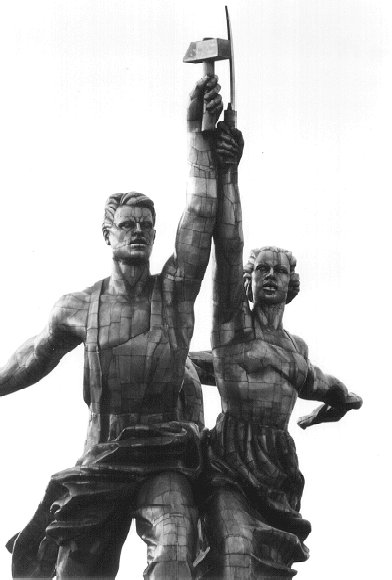
And one thing that all these monuments to Stalinism seem to have on the outside of the buildings are statues of the proletariat themselves. You can see these figures not just on the palace, but also on the side of buildings on Marshalkowska street. See the big, butch miner cradling his drill in his massive forearms. See the equally big and butch female worker with a dreamy look in her eye, holding what appears to be a tractor repair manual.
The figures remind me of the, almost homoerotic, description of miners having a shower after a hard day at the coal face in George Orwell’s, The Road to Wigan Pier.
But love it or hate it, the Palace of Culture has become, almost be default, the most recognizable symbol of Warsaw. Poles, though, have complicated feelings about the place.
Celebrations for the palace’s birthday party have been muted. Small collection of personal affects from the nineteen fifties when it was built are currently on show. The most interesting of these are the visitor’s books from the time. In massive letters one visitor scrawled: ‘This thing is absolutely horrible!’ Another entry from 1955 complains that, though the authorities had boasted of twelve lifts in the building, only one was working, and massive queues had formed to get to the top.
Queues, ugliness; all part, sadly, of the Polish communist experience.
Poles have never really known what to do with the Palace of Culture. There is now a massive clock at the top, and occasionally they use the place to advertise a film. When the King Kong remake hit the cinemas a few years ago you could see a blow up model of the great big ape climbing up the building.
But today, the only sign, from outside, of the building’s birthday is a smallish sign half way up proclaiming modestly, ‘I’m fifty years old’. But the sounds of champagne corks going off in Warsaw are noticeable in their absence.