

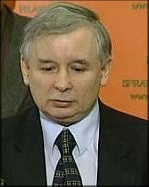
Lech Kaczynski sees support slip away as one of his staff puts his foot in it. (photo: Kaczynski back in the days when he was best buddies with Walesa).
Lech Kaczynski has sacked his campaign manager, Jacek Kurski, after he made false accusations that Donald Tusk’s grandfather volunteered to fight for the Nazi’s during WWII.
Kurski had told a weekly magazine that, “Reliable sources in Pomerania [the area around Gdansk where Tusk is from] say that Tusk’s grandfather volunteered for the Wehrmacht."
Donald Tusk immediately quashed the story by proving that both his grandfathers had fought for AKA (resistance) during the war, and spent some time in a concentration camp for their troubles.
Kaczynski has responded by apologizing to Tusk and sacking Kurski. He claims that the comments were made without his consent, and that he new nothing about the allegations before they appeared in the weekly Agora. Kurski has defended himself by saying that the comments came at the end of a long interview with journalists, who constantly questioned him on rumours about Tusk and his family. Finally, he says, he admitted that there 'were rumours', but did not say that he thought this gossip was true.
Nevertheless, how much has the affair damaged Kaczynski, who prides himself on his honesty and straight talking approach?
According to a poll published last night on the daily Fakty newscast on TVN, Tusk has now increased his lead on Kaczynski to 24 points - though another by OBOP finds that this lead to be 12% - still a movement away from Lech by two points, at 56 - 44%.
This all comes on the back of Lech Walesa announcing that he is rooting for Donald Tusk in the second round on October 23. Kaczynski used to be Walesa’s second in command in Solidarity, and was thought to be the heir to his thrown.
And then they had a few arguments. Big ones. Legal writs have flown, and many a bad word said.
So Walesa voting Tusk is another kick in the marginals. It’s not been a good few days for the Duck.
Thursday, October 13, 2005
Duck suddenly gets that sinking feeling

Tuesday, October 11, 2005
They also ran

A champion bridge playing monarchist who eats his tax returns, and a man who met his new Chinese wife on the internet, were just some of the also-rans who stood in last Sunday’s presidential election. (photo: Janusz Korwin-Mikke and running mate)
The fact that Lech Kaczynski, from the populist, conservative Law and Justice party, and Donald Tusk from the free market conservative, Civic Platform, have gone through to the second round on October 23 was always, what epistemologist Donald Rumsfeld would call, a ‘known, known’. They were both so far ahead in the polls that they were the only two real candidates with a hope of winning the contest.
The known-unknown was the turnout out, which at 50 percent, was a good ten percent higher than in the general election only two weeks ago.
But most of the other ten candidates who stood on Sunday knew that they had no hope of winning, and would be happy to get 1 percent of the vote.
What Rumsfeld would call the ‘unknown unknown’, is, of course, unknowable – but it probably has something to do with the question: why do these political also-rans bother in the first place?
Take for instance someone who is now becoming a veteran of presidential election contests, Janusz Korwin-Mikke, who used to stand on the “Real Politics’ platform, but now just stands on the Korwin-Mikke Platform platform.
If I said to you that Mr. Korwin-Mikke is the type of man who always wears a bow tie, then you will get an idea of the sort of person he is. He’s an intelligent, self-styled political maverick. He has some crazy ideas, which, once you think about some of them, at least, start to make a peculiar kind of sense.
He was a dedicated and brave anti-communist activist from the nineteen sixties onwards, managed to get himself arrested several times, and spent sometime in jail during the martial law period.
Towards the end of communism he set himself apart from the mainstream opposition with his Real Politics Union. He is for a low, almost non –existent tax economy, and onetime stood outside the finance ministry eating his tax-returns form. He is vehemently against the European Union (EU), the rules of which he sees as being less liberal than the old Soviet Union. ‘Brussels is run by a bunch of ‘Euro-Masons’, he says. He favours Poland leaving the EU and joining NAFTA, the North Atlantic Free Trade Association. That Poland is nowhere near the North Atlantic is not a problem for him.
Always the contrarian, he thinks that Poland should not interfere in the politics of Belarus, and President Lukashenko – someone usually thought of as a foreign relations pariah – should, indeed, be left alone.
The man is a mass of contradictions, in fact. Some of his views are hyper-modern, but others are from a different, forgotten age. For instance, he has some chauvinistic views about the role of women today, and is a member of the Polish Monarchy Club – which think that we should search for the rightful heir to the Polish throne.
He is also a champion bridge player.
His election slogan in the presidential elections this time – he has stood twice before – was the simple: I’m as fed up as you are! On Sunday, he polled 1.4%.
A political eccentric, then. But at least he does have political views. In fact, some say has too many of them.
Chinese crackers
This cannot be said for another of the candidates on Sunday, the oddball Stanislaw Tyminski.
Tyminski truly is the ‘unknown unknown’ of the Polish political scene. A Polish born Canadian businessman, he first emerged from obscurity in 1990, when he announced that he was going to stand in the nations’ first democratic ballot for president since the fall of communism the previous year.
But nobody had heard of him before, he didn’t seem to have any policies, and he was up against solidarity activists, and, most importantly, Lech Walesa.
In the first ballot, Walesa was miles ahead of everyone else, except that is, for Stanislaw Tyminksi, who amazed everyone when he forced a second ballot with the King of the Gdansk Shipyard. Walesa won the second round easily; but how could a candidate from overseas just turn up and get so many votes?
But this is what people like Tyminski are for. They are the anti-politics candidate. They have no past, so they cannot have made any mistakes. They have no policies, so it’s impossible to debate with them. And people vote for guys like Tyminski for no other reason than to stick a finger up at the political class in general.
But maybe because he was the politician that emerged out of the blue with no policies, the 57 year old - who didn’t even live in Poland - quickly disappeared again.
Only to re-emerge, that is, this year with a 37 year old Chinese woman on his arm, who he announced to be his new wife.
Apparently they met only a while ago on the internet. How they communicated was a mystery, as Wu Mulan - a labourer from Shenzhen, who has a 13-year-old daughter - didn’t speak any English. The first time they set eyes on each other was on their wedding day.
Rumours have been rife on the internet about the marriage, with talk of how this Chinese Cinderella is really an undercover spy trying to affect the results of the Polish presidential election.
Which is possible…but then again, why would the Chinese Secret Service waste time with a presidential candidate like Tyminski who, this time round, only polled 0.16 percent?
Still, the also-rans got what they were looking for – a bit of attention, and in Tyminski’s case, a pretty Chinese wife.
Sunday, October 09, 2005
Tusk leads duck
Donald Tusk and Lech Kaczynski will contest a second round in the presidential election in two weeks time.
Another late swing to Kaczynski (PiS) sees him within two percent of the leading candidate for president, Donald Tusk.
Turnout was up by ten percent on the parliamentary elections two weeks ago.
The third and forth placed candidates polled better that expected, with Andrzej Lepper and Marek Borowski polling 15 and 10 percent.
The question now is: who will get those votes, Tusk or Kaczynski (nickname, the duck)?
The majority of the votes for Lepper - according to TVN 24 - may go to Kaczynski, and most of Borowski's will go to Tusk.
I went along earlier with girlfriend, Ania, and the dog, to ballot station 175 - which, in another life, is the local school. As the dog and myself were ineligible to vote, we waited outside in the sunshine and watched a few, mainly young, people go in to put a cross beside the name of one of the 12 candidates.
The election official said that a steady trickle of people had turned out to vote. It just after lunchtime.
Ania voted for Tusk. She is Tusk’s core voter. Born in Warsaw, mid-thirties, university graduate, marketing manager in a TV company, thinks she pays to much tax. Secular. Thinks Kaczynski is old-fashioned. Thinks Tusk is a decent guy, and might reduce her taxes.
At 4.00 p.m. 35% had voted – that’s eight percent more than at the same time in the parliamentary election two weeks ago.
In a joint interview on TVP public television after the exit poll was announced at 8 p.m., Tusk gave some advise to Kaczynski: ‘It’s time to give up, man!’ But the race is now much closer than the opinion polls had indicated before Sunday's vote.
Friday, October 07, 2005
Boring!
What is this electoral obsession with gays all about? (pictured: Bosak Krzysztof, youngest MP (23) in the new parliament, League of Polish Families)
As Gustav points out at the Warsaw Station (top blog!) the Law and Justice part of the new rightwing coalition has lost no time in getting stuck in to pedaly (queers). Gustav writes, under the headline, PiS bigotry already rears its ugly head:
‘Poland's likely next prime minister, Kazimierz Marcinkiewicz, has described homosexuality as "unnatural" and believes the state should stop gays "infecting" others with their behaviour, according to an interview. "The spread of homosexuality is a threat to the liberty of other citizens, Marcinkiewicz, named by the conservative Law and Justice (PiS) party to lead the next government, told the Polish edition of Newsweek. "If a person tries to contaminate others with his homosexuality, the state should intervene against such an attack on liberty," he added.
"Homosexuality is not natural. What is natural is the family. The state must protect the family," said Marcinkiewicz, a devout Roman Catholic and father of four.
The PiS party won the most seats in legislative polls held on September 25 and has been in talks with second-placed Civic Platform on forming a coalition government.
In June, when he was mayor of Warsaw, PiS party leader and presidential candidate Lech Kaczynski banned a gay parade in the capital.’
Indeed. One of the saddest things about the election campaigns in Poland this time is how many times gays have been turned into modern day folk devils, just so that a few political pygmies can pick up a few cheap votes.
I was on the Tolerance Parade, the gay and lesbian demonstration in June. This was the march that was banned – not just this year, but last year as well - by the presidential candidate, Lech Kaczynski.
I thought long and hard before I joined that march. Not because I didn’t think it was an important issue in Poland – far from it. Not because I was scared someone might think I was gay - because I am not, but I don’t care if people think that I am. And not because I had never been on a march like that before, because I have done, many times (we have had a little bit of trouble in the past in the UK with troglodytes as well).
The reason I was uncertain was because I was not Polish - so did I have a right to get involved?
And then I thought about the EU. Here is Brussels, trying to get involved in all sorts of ways in Poland – from above. So what was the harm in me trying to help change things from below?
So I went on the march.
I wrote about this in How to Spoil a Skinheads Weekend. On the countermarch by far-rightists that day was, the now, youngest member of the new Polish parliament – Bosak Krzysztof. It was his gang that pelted us with eggs and rocks. If you have never been pelted with eggs and rocks by a gang of weirdo zealots, then I can tell you that it is extremely irritating.
Anyway, it seems that making homophobic soufflé is a good thing to put on your CV in Poland, if you want to be a far-right politician and get on in the world, that is.
But apart from the dairy produce deluge, we – about 3,000 people of various sexual persuasions – had a much better time than the few hundred, angry thugs. It was good to know that there are people in this country who are not going to put up with this sort of crap.
But the opportunist use of primitive prejudices by Marcinkiewicz this week only encourages people like Krzysztof, and that pathetic little bunch, to throw more eggs and rocks, and get worked up about something that is no threat to them at all. It’s time to grow up, guys.
Poles lack double vision

Half of Poles do not want twins as president and premier
The weekly magazine Polityka writes this week that almost 50 percent of Poles are worried at the prospect of the Kaczynski twins grabbing both top jobs. Poles are afraid of situations where top officials are related.
Polityka reminds us of when one of the leading figures in the Civic Platform, Zyta Gilowska, left the party amidst accusations that she was using her position to back her son’s candidature as an MP.
It is only among those who say they will defiantly vote for Lech Kaczynski this weekend who do not mind getting double vision when looking at the next Polish political leadership.
Polityka thinks that Tusk is a better choice because his presidency would ensure a balance of power between Civic Platform and Law and Justice. ‘It’s nothing personal’, the weekly tells Lech Kaczynski. ‘The principle of limited trust has to be applied even in relation to trustworthy persons, just in case.’
Fourth Republic

President Kwasniewski might vote for Tusk, and Kaczynski is 'too radical'. (pictured: Kwasniewski with Bush)
The outgoing president, Alex Kwasniewski, said yesterday – as he was endorsing no-hoper Marek Borowski for the job – that he thinks the program of Law and Justice in general, and candidate Leck Kaczynski in particular – is ‘too radical’. “We have to look for politicians who will not waste Poland’s achievements so far, but will use and develop them”, Kwasniewski said.
Besides the fact that Kaczynski is a ‘conservative’, - and conservatives do not usually go in for being ‘radical’ - what could he mean by this?
The Kaczynski election posters refer to a Polish ‘Fourth Republic’ – which does not exists at the moment. And that’s the point.
The Thirst Republic came into force after the fall of communism in 1989. Before that we had the Commie “People’s Republic', and then before that we had the Second Republic, which came into force after Poland regained her independence after WWI.
What Kaczynski – and much of the Polish rightwing – are arguing for now is a Fourth Republic, signaling the end of the post-communist phase of the nation’s reconstruction.
Kaczynski et al think that the gradualism of Poland’s approach after 1989 - when many of the former communists were allowed to stay in the civil service and top levels of the public sector – should be abandoned, and the ex-commies purged from positions of power – e.g. the Television and Radio Council, that watches over broadcasting in Poland, should be abolished.
In other words, the Fourth Republic would be a commie-free-zone, something which many ex-communist countries did right from the start.
President Kwasniewski, not surprisingly, does not go along with this, as he is one of those ex-commies (though of the reformist type).
If the presidential contest goes to a second round – where the top two contestants fight out a head-to-head battle in two weeks time – then President Kwasniewski has implied that he will be voting for Civic Platform’s Donald Tusk, as the lesser of two evils.
Wednesday, October 05, 2005
Presidential candidate: Andrzej Lepper
.jpg)
In third place in the opinion polls (12%), he’s fighting for the rights of farmers, pigs, and Alexander Lukashenko.
He’s the maverick isolationist who is anti-EU, anti-Atlanticist, and anti-globalist. He’s the ex-boxer who’s been in court more times than a Polish grandma has cooked up bigos. And he is the self-styled modern day Polish Robin Hood, who has about one in ten Polish voters cheering him on.
I have seen him described by the foreign press as being on the ‘far right’, but this completely misses the point about politics in a post-communist country like Poland.
Up until 1992, Lepper was a pig farmer who was a member of the PZPR, the old communist party. When his farm hit hard times he decided it was time to fight back against the ‘shock economic therapy’, and savage free market reforms of the newly capitalist Poland.
So he formed Samoobrona (Self Defense) the radical farmers union. Lepper quickly became a constant media presence – organizing roadblocks to keep out cheap imported grain from the EU and elsewhere. His direct action method of protest attracted the attention of not just the news media, but also the cops, who arrested him countless times for obstruction and other public order offenses.
Samoobrona’s party song is a jolly little ditty that makes plain the Lepper mindset: “This land is our land, and we won’t let anyone punch us in the face.” Catchy, isn’t it?
He first stood for president ten years ago, when he polled just over one percent. The next time he tried, in 2000, he got three percent. This time he will probably get around twelve percent. So things are going in the right direction for the man who is attracting the disaffected and disposessed in modern day Poland.
He has made anti-Semitic remarks in the past, which is probably where the ‘far right’ tag comes from. He has praised Goebbels for his mastery of the media, and Hitler for his ‘economic policy.’
But he has also expressed regard for someone who is usually thought to be a bit of a basket case, the President of Belarus, Alexander Lukashenko. He supported Lukashenko’s successful attempt to change the constitution so that he could stand for a third term as head of state. Lepper thinks that he should be president ‘till he dies.’
King of the Polish populists
Lepper is a strange mixture of two French populists: Jose Bove – the darling of lefty anti-globalists who once drove a tractor through his local MacDonald’s - and far-right, neo-fascist, Jean Mari le Pen.
Like Hitler, he is a lover of our fury friends, and campaigns for the rights of farm animals. In Washington D.C. in 2001 he was awarded the Albert Schweitzer Medal for his campaign for more humane farming. He vows to ‘stop the concentration camps’ of modern farming methods in Poland. “Farm animals are like any other living being, and have natural instincts that must be expressed.”, he told a doting American audience.
Foreign policy under Lepper and Samoobrona would turn Poland into, well, another Belarus. He is as suspicious of American capitalism as he is of the interventionism of the EU. He accuses both of dumping surplus agricultural products on the Polish market, with the full permission of the government. And as far as the domestic economy is concerned, he would slow down privatization, and make sure that Polish firms stay in Polish hands.
So, all in all, Andrzej Lepper is an oddball, and someone who defies the usual political labels of left and right.
He won’t get into the second round of the presidential elections, but he can always be relied upon to liven up Polish politics a bit. Political journalists, in particular, would miss him if he were ever to fall under a tractor.
Tuesday, October 04, 2005
Not so cunning linguists

New regime is in need of language lessons.
What have outgoing president, Aleksander Kwasniewski, outgoing prime minister, Marek Belka, and former foreign secretary and onetime presidential candidate, Wlodzimierz Cimoszewicz got in common?
Apart from being members of the ex-communist SLD, they are all fairly proficient in the English language.
Kwasniewski, for instance, learnt his English when he came to London in the early nineteen seventies and worked (illegally!) in a pub just round the corner from the Arsenal football ground. As a consequence, he’s been inflicted with a lifelong support of the north London club, but a good knowledge of English as compensation.
But who at the top levels of the new rightwing coalition can match the ex-communists in the linguistic department?
The short answer is, not many. Law and Justice’s (PiS) Oxford graduate, Radek Sikorski speaks fluent English, with an almost aristocratic accent. Former head of the central bank, Civic Platform’s Hanna Gronkiewicz-Waltz speaks well, so do MEP’s like PiS’s Alan Bielan.
One of the main players in Sunday’s presidential election - and someone who has had a slight movement in the right direction in the last few`days in the opinion polls - is Lech Kaczynski. But he doesn't speak any English at all.
Donald Tusk - the odds on favourite - does know some, but it very shy about speaking it. We tried to get him to talk in English when we were doing a kind of profile about him a while ago. But he got ‘mic fright’ and refused to do it. The same happened when a colleague of mine door-stepped him in the radio building, and again, he refused to play ball.
The British Council has been putting on classes for politicians who want to learn the lingo of international diplomacy, but we can’t find out what kind of level.
So English speaking heads of state will be hoping Tusk gets the nod this weekend. I just hope there are not many microphones around when they meet him.
Monday, October 03, 2005
Poland gags journos

Poland has the worst record in the EU for using the courts against journalists, says the International Press Institute (ITI).
The claim is made in two recent letters from the Director of the IPI, Johann P. Fritz, to Aleksander Kwasniewski, Poland’s outgoing president. The letters are in supprt of two national newspapers, Rzeczpospolita and Gazeta Wyborcza, and two weekly current affairs magazines, Wprost and Polityka.
The first correspondence is in support of Grzegorz Gauden, the Editor-in-Chief, of the upmarket Rzeczpospolita daily, who is being charged by Warsaw prosecutors of the ‘propagation without a permission [of] news about the preparatory proceedings’ – meaning, reporting evidence included in court proceedings that have yet to come to court.
An article in Rzeczpospolita on 18 March this year claimed that a former head of Poland’s largest insurance firm, PZU, Wladyslaw Jamrozy, had, in 1995, allegedly founded a secret trust fund on the UK island of Jersey and transferred company funds to the account.
The accusations follow several others made against PZU and it’s former president, who was suspended in 2000 for allegedly trying to illegally assist the takeover of a Polish bank by Deutsche Bank. Jamrozy has always denied the accusations.
The PZU affair has been one of many high profile corruption cases over the past few years in Poland.
Why use the courts to fight their battles?
The charge against the journalist – made on August 24 - is seen by many to be a gagging order against investigative journalism into the sleazy goings on between the outgoing ex-communist government and individuals in high positions in public companies.
The IPI states in the letter to President Kwasniewski: “The prosecutor's office is seriously impeding the work of an independent newspaper and it raises the possibility that Polish editors who find themselves in a similar position will practice self-censorship in order to escape criminal prosecution.”
In the second letter to the president, the IPI raises concerns over other recent cases of court harassment of other weekly and daily publications.
In light of the fact that Transparency International has found Poland to be the most corrupt country in the EU, it is vital, argues the IPI, that Kwasniewski removes, “…all criminal laws that hinder press freedom and freedom of expression and to ensure that the media's right to report in the public interest is fully protected.
I hate to disappoint the IPI, but President Kwasniewski certainly will not be removing any laws that hinder the press, or otherwise, as he will be no longer the head of state in a couple of weeks time, after the presidential elections. And he could not remove laws against press freedom anyway, as the Polish constitution does not give him any powers to do such a thing.
But the case does show that the courts are being used to strangle rights to free expression in Poland.
On January 25, Jerzy Urban, the editor of the savagely satirical Polish weekly NIE (No), was convicted and fined 5.000 euros for insulting John Paul II.
Urban broke an obscure law in the Polish penal code (article 136.3), whereby it is a criminal offence to insult a foreign head of state (the Pope is the head of Vatican City, a small but nevertheless independent state).
The verdict came just after two Polish journalists, editor of Wiesci Polckie Andrzej Marek, and Beata Korzenewska, a journalist working for Gazeta Pamorska, were jailed for libeling a public official.
It seems that Poles fought for decades for freedom of speech, only to see that freedom become contingent on not upsetting anybody.
Saturday, October 01, 2005
Poland and the cheshire cat in Downing Street

On taking over the EU presidency in July he promised to drive forward ‘necessary reforms’, and would ‘sort out the EU’. And then he disappeared into thin air, leaving only a grin behind him.
After making his speech in June outlining his plan for a more flexible Union and a reformed CAP, the eurosceptic tabloid The Sun, called Blair a "brave British gladiator walking into the lion's den". They did say to be careful of the once Europhile who could, you know, speak a bit of French, but then said, "But we do not carp. Instead we rejoice as a political sinner repents."
And then, all of a sudden…nothing happened. Was he a repenting lion, or a distracted pussy cat, many euroskeptic Poles wondered?
But now he’s back. Tony Blair has said that he is going to re-focus on the EU. His centerpiece is going to be a deal on the EU budget, and skewering together an agreement on Turkey’s membership on October 3.
Helping in his re-introduction as EU lion is the rightwing victory in the general election in Poland. As usual, New Labour are much more comfortable these days with rightist foreign relations. The German election result – a kind of daschund’s breakfast – was a knock back. And then Law and Justice and Civic Platform served up the kielbasa.
Deputy Prime Minister John Prescott – obviously a fan of Polish sausage - has spoke of a new ‘special relationship’ between the two countries.
And that relationship will surely center on maneuvers in Brussels.
There will now be no EU constitution in its present form. The Polish line will be to try to keep things much as they are. That’s how Poles thought things would be when they voted to join the organization in the first place. Poland – with a population of nearly 40 million – is one of the larger EU countries, and the Nice Treaty gives it more shout than the subsidiarity in the Constitution.
And that’s a bit of a relief for Tony, because now he doesn’t need to have a referendum he would surely loose.
Poland will be adopting the euro later rather than sooner. The budget draft that the outgoing SLD government has just agreed to, envisages meeting criteria in the Growth and Stability pact as soon as 2008! Poland’s budget deficit of over six percent will have to be brought down rapidly. That means ruthless cuts, and a high growth rate, that the outgoing government probably couldn’t manage anyway.
The new government – now that Law and Justice, and not Civic Platform are the boss - will be in so such a rush.
Further political integration will now, either come to a grinding halt, or turn to a two speed Europe. If it's the latter, Poland will be riding pillion in the slow lane with the UK.
And Poland, like New Labour, will be looking more to Washington than to Brussels as far as defense policy is concerned.
But this might wipe the smile of his face
Blair would be naïve to think that it’s going to be all vodka and sausage with the Poles. One of his intended reforms is to the EU’s agriculture budget. In the future he wants individual states to be largely responsible for subsidizing their own farmers.
He said recently: "I totally understand why countries may want to give their money to support farmers. What I have an objection to is the European Union deciding collectively it is going to give 40% of its budget into an area that has got 4% of its people. “
The trouble is, is that Poland has two million farms, and a quarter of its population rely on the farming industry for its living. A large section of Poland is part of the four percent Blair was talking about. Many farmers are now receiving a nice whack of subsidy from Brussels, and they rather like it. They have also seen agricultural exports go up 40% since joining the EU last year.
So Blair will have a friend in Brussels for much of the time. But Poland will be shifting its alliances to suit its needs, and at the same time keeping a close eye our Tony, and making sure he doesn't disappear again.
Blogs and elections
Interesting statistics on blogherald.com showing that Germany is way behind Poland and France in the blog stakes.
Written in early September, and under the headline, Blogs starting to make an impression in the German election, it says:
"Germany statistically has one of the lowest number of blogs per head of population in Europe, according to the last Blog Herald Blog Count in July, and notably lags behind its neighbours France and Poland. Deutsche Welle reports that Germany is still 'in the teething stages when it comes to political online journals' however a number of blogs are now starting to be heard."
Statistics for July report that, “Figures also indicates that Poland is one of the fastest growing blog markets in Europe.” Poland has just under 1.5 million blogs, while Germany has a pitiful 250,000.
Does this mean that one of our blogs could swing the presidential election?
Silent majority

Why are Poles so allergic to the ballot box?
The General Election last Sunday had a turnout of around 40 percent. This is low even by Polish standards, where the ballot box has never had a particular allure. In the 2001 election, turnout was only 46 percent.
Many leftwing voters in industrial heartlands didn’t bother to leave the house this time, after the left wing government failed to tackle the 1 in 5 unemployment rate, and the seemingly endemic corruption in their ranks.
Others have simply abandoned the political process altogether. One non-voter I talked to said that the election ‘didn’t matter’. He didn’t think that voting one way or another would make any mark on the future of his country. All the real battles had been fought, he said, and whichever party won would not make that much difference. And then – with almost pride, I think! - he claimed membership of what he called, ‘the silent majority’.
One non-voter told Euronews: “All of these people were in power already. I am against all of them. They have ruled for 15 years - the names of the parties kept changing but the faces stayed the same."
The standard commentary has noted the growing cynicism for politics in general and politicians in particular. And this mood of powerlessness and disengagement is felt most strongly in low-income groups and the poorly educated.
In the Euro-elections last June, barely 20% dragged themselves out to vote. President Kwasniewski told TVN 24 back then that lack of voter interest in the democratic process was ‘an illness’ and ‘had to be studied.’
The highest turnout in recent times has been in the 2003 referendum on whether Poland should enter the EU or not, where over 60% of voters went to the polls.
But Poles have never shown a great interest in elections. Even in 1989, in the first democratic elections since the nineteen twenties in this country, only 64% voted. By 1997 that figure had slipped to under 50 percent.
So the argument that Poles have become cynical about politics is a weak one. Poles have not become cynical, they always were.
Politics in a post-political world
Since 1989 voter turnout has been falling in western Europe. With the great left/right ideological battles a thing of the past (There Is Now No Alternative to Capitalism), and societies becoming more and more fragmented and atomized, social cohesion and responsibility has weakened.
And political parties – which once had genuine roots in societies – have become detached from the people.
In 1950s Britain, for example, the Labour Party claimed a membership of about a million; today that is down to under 300.000. Over the same period membership of the Conservative Party declined from some 2.8 million to less than half a million – and the average age of its members is over 65.
But Poland is a country that never really has had much cohesion - due to obvious historical reasons - and all the political parties (bar the ex-communists, ironically) that contested Sunday’s election are less than ten years old. They have no grounding in Polish society at all.
And the individual’s relationship to the state, and to his or her community, has always been a difficult one here.
So without political alternatives and a strong civic society, voting can seem irrelevant.
And that’s why the ballot box is a stranger to most, and why the silent majority has become a permanent feature on the political landscape.
It is becoming almost trendy to be a political cynic, these days. But leaving politics to the politicians is not a solution to anything.
The only way forward is for politicians to be encouraged to present real alternatives to voters, and for voters to form strong communities and re-engage with the world around them.
Until then the Cynicism Party will always be the real winner in elections in Poland.
Friday, September 30, 2005
Winners and losers

A rock star, a surgeon and Lech Welesa’s son are all new members of the Sejm, the Polish parliament.
The most popular politician in Poland, officially, is leader of Law and Justice, Jaroslaw Kaczynski, who received 170,000 votes in Warsaw.
Other politicos with reasons to be cheerful include 30-year-old son of Lech, Jaroslaw Welesa, who will be representing Civic Platform.
Celeb MP’s include the singer of Polish rock dinosaurs, Budka Suflera, Krzysztof Cugowsk, who is representing the very un-rock and roll Law and Justice in the Upper House, the Senate.
Robert Costa enters parliament after a career as a surgeon. Born in Bangladesh he returned to Poland 30 years ago, and is now an MP for the radical farmer’s union, Self Defense (Samoobrona).
But who is the most miserable politician this week?
Well, that honour could go to Jan Maria Rokita, who went to bed the night before the election dreaming of being Prime Minister. But when he went to bed in the early hours of the morning after the election those dreams were in tatters. His Civic Platform failed to become the biggest party in parliament, and he will probably have to settle for the job of Foreign Secretary. But his problems don’t end there. Even in his own constituency of Krakow he lost a considerable amount of votes to the Law and Justice candidate.
One of the biggest shocks of the night last Sunday was that leader of the far-right League of Polish Families, Roman Giertych, failed to get into the Sejm. (correction - see comment)
And former Prime Minister for the ex-communist SLD, Leszek Miller – who resigned the day after Poland joined the EU in May last year, decided not to stand at all for election this time, as it was pretty obvious that he would get virtually any support at all this time round.
Taxing negotiations
Future ministers on the Law and Justice side of the future coalition government said this morning that negotiations have already turned into ‘a political TV reality show’.
On Thursday, Polish media were suggesting that a possible breakthrough was close between Law and Justice (PiS) and Civic Platform (PO), the two parties which will be making up the next Polish government.
PO stood on a low 15% flat-income tax policy in the elections, whereas Law and Justice gained many votes appealing to poorer members of the electorate who feared that tax cuts would mean cuts in benefits and pensions.
The talked about deal was said to involve an 18% flat tax, higher than Civic Platform had promised if they had been the largest party in parliament, but a flat tax all the same.
Law and Justice spokesmen have since muddied the waters somewhat. They have said that they want tax incentives to be put in place for larger families – a kind of reverse Chinese tax policy, and a very Catholic proposal if ever there was one – and that they suggest a progressive tax system of between 18 and 32 percent.
This is a reaffirmation of the position that they campaigned on. But a closer look suggests that this is a flat-tax policy in all but name. Ninety nine percent of earners fall into the 18 percent tax bracket, leaving only 100,000 in the top bracket.
The position of little-known economist, Law and Justive MP Kazimierz Marcinkiewicz becoming Prime Minister seems to depend on the results of the October 9 presidential elections. Many believe that if Donald Tusk from the Civic Platform becomes president, Mr Marcinkiewicz may be immediately replaced by Jaroslaw Kaczynski.
After talks yesterday afternoon an agreement seemed still some distance away. Political posing on TV followed, with Marcinkiewicz saying: "We are no closer to the coalition. We are still waiting for the Platform to say whether they want to build a coalition with us, or want me to make my own government."
We may have to wait until the second round of the elections scheduled for October 23 before the name of the new PM is known, if the contest goes to a second round.
Wednesday, September 28, 2005
Kazimierz who?

Why pick an obscure economist who virtually nobody has heard of before to be Poland’s new Prime Minister?
A least no one can say that Polish politics is predictable. First we get the surprise win of the conservative Law and Justice Party (PiS) – the largest grouping in the Sejm, the Polish parliament, after Sunday’s elections. Now we get a new PM that maybe only his wife, kids and close friends are entirely familiar with.
Kazimierz Marcinkiewicz is a mathematics and physics graduate, who has been linked with Catholic conservatives since the start of his parliamentary career 12 years ago. In the outgoing parliament he headed the treasury commission, which oversees privitisation policy. He is said to belong to the market-oriented wing of Law and Justice.
He's considered to be the author of his party's economic agenda - which is no great compliment as many have noticed that PiS don’t actually appear to have a clear economic policy.
It was assumed after the results were announced that the leader of PiS, Jaroslaw Kaczynski, would be PM, as he is the head of the largest party in the new parliament. The problem was that his twin brother, Lech, is in the race for the presidential palace in October. Many voters have told pollsters and focus groups that they do not want to see twins in both top jobs in Poland.
So it seems that Marcinkiewicz is being a ‘stopgap’ Premier until the results of the presidential elections are known. At the moment, it appears that the favourite for that post is Civic Plaform’s Donald Tusk, who would win a head-to-head contest with Lech Kaczynski by a 57-43 ratio.
Watch this space…
Read on:
Poland's centre-right coalition nominates Prime Minister, Euronews (video), September 28
Monday, September 26, 2005
Is the General Election result bad news for Tusk?
Many are wondering how a win for Law and Justice (PiS) and the low turnout will have consequences for the October 9 presidential election.
I have to say that I have been meeting some very disappointed people this morning. Things started to look bad for Civic Platform (PO) last Friday. The guy who does PR for Donald Tusk was heard saying that support was shifting slightly away from PO and to PiS. Apparently their own in-house polling was telling them that the PO brand was being seen as middle class and business orientated. Unsurprisingly, those not in those groups, and particularly those on fixed incomes like pensions and unemployment benefits were worried about how low tax and radical cuts in government spending would affect them.
Gustav (see comments) thinks that a win for Law and Justice is bad for Civic Platform’s Tusk. But maybe it makes things better for him. Jaroslaw Kaczunski’s comment that he will only take the PM job if his twin bruv Lech looses the presidential elections is good news for Tusk. Voters have been telling focus groups for sometime now that they do not want to see twin brothers in the two top jobs. And who can blame them?
The presidential campaign has overshadowed the presidential one – big time. I saw a Vox Pop on TVN last week and most people seemed to think that last Sunday’s election was the presidential one! They must have got a shock when they turned up to the opinion poll only to be given what looks like an examination paper with loads and loads of names on it.
The turnout – which at just under 40% is low even by Polish standards – might just have an influence, though. Are people going to drag themselves out for possibly two more elections?
But as Michael Farris says below, the presidential job is ill defined, and actually, not very important. The Polish president is a toothless beast, with only the power of veto and no real policy making abilities.
The real power is in parliament –and that now lies with a bunch of ill matched conservatives and free-marketeers. Expect lots and lots of bitching in the weeks to come.
No double trouble at the top
Jaroslaw Kaczynski has indicated that he will not take the job of Prime Minister if his twin brither Lech wins presidential elections
With sixty percent of the votes counted in the Polish General Election the conservative, Law and Justice have 26.6%, followed by the pro-business Civic Platform with 24.1%. The populist farmer’s union, Self Defense has 12.4% and SLD, outgoing ex-communists SLD have 10.9%, says the Electoral Commission.
The percentage of the votes translates to 151 seats in the Polish parliament, the Sejm, with Civic Platform gaining 123, Self Defense with 67, SLD with 51, the far-right League of Polish families with 36 and the PSL peasant’s party with 30.
A coalition between Law and Justice (PiS) and Civic Platform will form the new government, and negotiations will start soon this week. “We have long said that we want this coalition and there are no reasons why this shouldn’t happen,” said Jaroslaw Kaczynski, the favorite to become Poland’s next Prime Minister. kaczynski has indicated, however, that we will only take the job if his twin brother Lech does not win the October 9 presidential elections.
I have tried to find a photo of the two standing together, but they studiously avoid being in the same place at the same time so as not to confuse people.
Talks might be difficult, however. The economic policies of the two parties are notably different, with Civic Platform favoring a low flat- tax and Law and Justice less willing to make harsh reforms to the labor code and tackle Poland’s ballooning budget deficit.
Sunday, September 25, 2005
History repeats…
The results of the Polish General Election are familiar – the party that was in government is annihilated, and the turnout very low.
Poland’s next Prime Minister is probably going to be Jaroslaw Kzcynski, after a late swing to his Law and Justice party. In second place is Civic Platform, according to exit polls.
The projection of seats, if the counted votes tally with the exit poll will be: Law and Justice 157 seats, Civic Platform 147, Self Defense 47, SLD 54, League of Polish families 33 and PSL 5.
The major surprise there is probably that the outgoing government of the ex-communist SLD have got into double figures, percentage-wise.
The turnout though is the lowest in the history of free elections in Poland. Only thirty seven percent bothered to drag themselves to the polling stations.
But that is the only downside for Jaroslaw Kazcynski, who will be the first Prime Minister of Poland to be still living with his mum. Will she have an influence on his policies? Amd will he be setting up a kitchen cabinet?
In the last General Election here four years ago, it was the rightwing’s turn to get hammered in the polls. The then ruling Solidarity Election Action failed to get any MPs into parliament at all.
So the Polish left-right roundabout goes round again.
Which brings to mind something an old German once wrote when he was writing books in the British Library: History repeats – the first time as tragedy, the second time as farce.
Friday, September 23, 2005
Last minute scramble for votes

What to do when you are a conservative and your party is neck and neck with another rigthwing group in the polls? How about a bit of queer bashing?
In the last remaining days before the General Election, the result looks pretty clear. A coalition between right-wingers Civic Platform and Law and Justice (PiS) is on the cards. The only uncertainty is: which party will be the largest in parliament, and senior partner in the coalition? This matters, as the larger party will get the top job of Prime Minister, Finance Minister and or Foreign Secretary.
According to the last opinion poll (see scroll above) before Sunday’s vote, Civic Platform and Law and Justice should get around 170 seats each in the 460 seat parliament (Sejm).
Self Defense, the radical farmer’s union will get around 60 votes and the far-right, slightly barmy League of Polish Families, 36.
The SLD – the ex-communist, and current government party will get a mere 30 seats. At 7%, the SLD is dangerously close to the 5% limit – below that they will not even be in parliament at all.
Dire straights
So, a last minute scramble is underway to make sure core supporters get out and vote on Sunday.
Law and Justice – the more conservative of the two rightist parties – have been trying to appeal to the more base instincts of some of their supporters by raising the gay bogey man in Poland (yawn!).
"Homosexuals...should have normal social and citizen rights, but maybe they should not be employed in certain professions," said Jaroslaw Kaczynski, one of the twins leading PiS.
Professions he has in mind include school teaching. Kaczynski is playing on the primitive views of many of the electorate who ‘think’ that gays are somehow the same as pedophiles – a view, we should remember, that was common in the nineteen-sixties in the West.
Szymon Niemiec, from the Gay and Lesbian Association in Warsaw says: “'His remarks remind me of the 1930s. The Nazis also persecuted minorities.”
Law and Justice have a record of stirring up prejudice towards Polish gay and lesbians. This May, Jaroslaw’s brother, Lech, banned a Gay Pride march for the second year running in Warsaw on the grounds that it might ‘promote’ homosexuality. The European Court of Human Rights is currently looking at the case as the ban breaks EU agreements and the Polish Constitution.
Jaroslaw Kaczynski – who might be PM or Foreign Secretary after the election – is unmarried and currently lives at home with his mum.
Wednesday, September 21, 2005
The sad decline of the enlightened ones

As the UK Prospect magazine launches another survey to find who is the greatest living intellectual, it is a good time to look back at two of Poland's finest who both died in 2004 - Solidarity activist Jacek Kuron (pictured) and Nobel Prize winning poet, Czeslaw Milosz.
When I first came to Poland some years ago, sent by the university I was working for in London, my first days work at Warsaw Uni. involved filling out lots of frightening looking forms and other bits of paper. The kind person who helped me through the maze of red tape was a small lady with big hair. One of the buff coloured forms – which dated back to times of communism – asked me what my social class was. I was a bit stumped as to how to answer this question – nobody had ever asked me before. Seeing that I was at a loss, the nice lady with hair that seemed to grow upwards and outwards in great chestnut coloured bunches as I spoke to her, had a suggestion: “You’re intelligent,” she said. “Why, thank you,” I said, “but you hardly know me!”
“No, no,” she said. “You are intelligent. That’s your social class.”
What she meant, of course, was that she thought I was a member of the intelligentsia. I went back to my little hotel room and pondered this new development. The British, you see, have an instinctual dislike of anyone who goes around thinking that they are a member of the intelligentsia. To the Brits, the intellectual is someone who is ‘too clever by half’, and is ‘too clever for their own good’, and needs ‘taking down a peg or two.’ The Brits like practical thinkers, not someone who thinks simply for the sake of thinking itself. I mean, when did philosophy ever get the washing up done, or find a way to stop the growth of nasal hair?
To me personally, members of the intelligentsia (the word comes from the Latin and means ‘the enlightened ones’) are those who sit in cafes on the left bank of the Seine in Paris, sip absinth and discuss the unbearable lightness of being…or something.
But in Poland things are different. They used to say that the three great social groups in this country were the Church, the Military and the Intelligentsia. But the Polish intelligentsia were different from their Gauloises smoking, western-European counterparts. The intelligentsia here have their origins in the Polish noble class, the Szlachta. Up until the end of the 18th century this group regarded themselves as the embodiment of Polish culture.
Unfortunately, Poland in those days found itself between three competing empires – the Prussian, the Russian and the Austrian-Hungarian. And then empires did what empires do and carved up Poland into three pieces and the country disappeared from the map of Europe. The noble szlachta, as caretakers of Polish culture, found themselves out of a job.
So this group slowly fashioned themselves into the new intelligentsia, whose mission it was to keep the language and culture alive at a time of occupation.
Between the world wars, when Poland regained her independence, there was a brief flourish of intellectual and artistic creativity. And then the Second World War came and went, and so did the Nazis, only to be replaced by the communists.
The Polish intelligentsia once again found themselves a role in keeping the true Polish culture alive.
A thorn in the side
One of these intellectuals, Solidarity activist Jacek Kuron, died in 2004 at the age of 70. Originally a member of the Polish United Workers Party (the communists) he resigned in 1964. After that Kuron remained a thorn in the side of the authorities for two and a half decades. He spent time in jail and was seen as the spiritual and intellectual guide to the resistance to communism. The key to understanding Solidarity is that it was a solidarity between the workers – led by Lech Walesa - and the intelligentsia, led by the Workers Defence Committee (KOR), of which Kuron was a leading thinker. After the fall of communism Jacek Kuron spent sometime as Labour Minister, but generally kept his political independence, and consequently, the respect of the Polish public.
But another is always born
Another Great Polish Intellectual to die last year was Czeslaw Milosz, who won the Nobel Prize for Literature in 1980. Though he spent much of his life writing in exile in France and America, Milosz was seen as the most important poet in post-war Poland. Again, like Kuron, he was initially part of the communist set up here, but defected to Paris in 1951. His most famous work outside Poland, 1953’s The Captive Mind, (banned as all his works were during communism) revealed the problems that intellectuals experience under Stalinist regimes.
He returned from California to Poland to pick up the Nobel Prize in 1980. This was the year of the Solidarity strikes, which eventually brought about martial law. It’s easy then to understand why the committee of Norwegian academics that give out these prizes decided to give it to Milosz that year…Nobel prizes are as much political as they are artistic.
Milosz died on the 14 August, aged 91.
So that’s two members of the Polish intelligentsia less than we started the year with. But the problem for this social group is that it is seen in this country as being redundant. Poland has its independence now, and doesn’t need these guardians of Poland’s culture. And who gives a toss about thinking anymore these days, when we are all too busy going shopping? Where as once people wanted to be university professors, now they would rather be a PR consultant.
So the intelligentsia class is on the way out here, its job done. The decline of the Polish enlightened ones is nearly complete.
I should leave you with a line or two from the poetry of Czeslaw Milosz, I suppose. Here are just two lines from a poem that you can see on the monument to Solidarity, unveiled in 1980 at the Lenin Shipyard, Gdansk. It says:
Do not feel safe
The poet remembers
You can slay one,
But another is always born
Flat tax: is it a good idea?

One of the issues that is dividing the right wing parties set to form the next coalition government in Poland is whether the nation should follow other central European, ex-communist countries and adopt a flat tax system. (photo: Hanna Gronkiewicz-Waltz)
Leading Civic Platform figure in Warsaw, and onetime Head the Central Bank in Poland, Hanna Gronkiewicz-Waltz, is one who thinks that having low tax for everyone – including the rich - is the way forward for an economy like Poland’s. She told Radio Polonia this week:
‘Countries which adopted a more liberal approach are much more successful than those countries which adopted more socialist visions in the past. Our program is not only for the rich but also for unemployed people, because in Poland we have high unemployment, about 18 percent, so we would like to reduce taxes, reduce the cost of labor and introduce a flat tax. We think that it increases the contribution to the budget and it means that there are more incomes, more revenues.’
Low, flat tax policies have been put into practice in Slovakia. In 2004 it swept away 21 categories of personal income taxes, five tax brackets, and scores of exemptions and deductions, replacing them with a flat 19% rate. Politicians there say that this has brought in much needed investment and stimulated the economy, creating thousands of jobs.
The flat tax system is also good, say believers, for dragging people out of the black economy. Poland has thousands in work who don’t pay any tax, or social security payments at all.
Law and Justice (PiS)– a populist rightwing, conservative party who will be in the coalition with Civic Platform – disagree. They think that the priority should be to those on low incomes and the unemployed. Adam Bielan from PiS told us:
‘The Civic Platform is a classical liberal party. Their proposal of flat tax is not acceptable for us because we think that 25 years after Solidarity was born we also need more solidarity, and we are afraid that with these proposals real populist parties like Samoobrona could win the next general election after this one. So it could be quite dangerous for the stability in Poland.’
Government-to-be squabble over who gets the top jobs
A move in favour of Law and Justice in the most recent opinion poll suggests that who will get the top jobs in the right wing coalition after the general election on Sunday is not as clear cut as many thunk.
After weeks of being out front in the polls, Civic Platform has been overtaken by the conservative, Law and Justice party.
The largest party in parliament will probably be the one which gets to pick the Prime Minister. If Law and Justice stay in the lead then this means that Jaroslaw Kaczynski could well be Poland's next PM.
Earlier this month, when it looked like Civic Platform were certain to be the biggest force in parliament, law and Justice's Lech Kaczynski demanded that a fair share out of the jobs was a precondition to any coalition negotiation. “"If [Civic Platform] will have its prime minister and finance minister, we want to have our foreign affairs minister."
Donald Tusk, leader of the Civic Platform retorted that he would not be entering into any such negotiations via the media, and this is a matter best left till after the last vote is counted after the poll.
But the new poll finding - if reliable - has thrown all this into doubt. The OBOP poll may be a rogue, however, and goes against all recent polls that put Civic Platform in the lead by 2 to 5 percent.
Tuesday, September 20, 2005
Not so quiet on the western front

While domestic issues dominate the election campaigns for Polish president and parliament, the candidates’ stand on foreign policy might just pick them up a few votes, too.
As the German election results came in on Sunday night, many here – including me - were scratching their heads with disbelief: how can an electorate connive to produce a scenario where no side wins an election? After all, German politics is not supposed to resemble a cricket match.
The commentators tried to explain the possible future coalition options: a ‘traffic light’ coalition between Gerhard Schroeder' red Social Democrats, plus Joschka Fischer’s Greens plus the yellow Liberal Democrats; or would it be the red, red, green coalition of the Social Democrats, the Greens and the ex-communist left? Or maybe it would be the worst possible result of a Grand Coalition of leftist red Social Democrats and rightist black Christian Democrats?
A confusing situation for everybody, but just imagine what it must be like to a German who is colorblind?
Before Angela Merkel managed to somehow snatch defeat from the jaws of certain victory, it was expected, and hoped by most in Poland, that her Christian Democrats would be the winners. But the leader of the Christian Democrats has apparently had Personality By-Pass surgery and was no match for the tub-thumping charisma of the incumbent Chancellor, Gerhard Schroeder.
But would foreign policy be any easier between Poland and Germany if she had of held on to her lead in the opinion polls in the run up to polling day?
It is in Poland’s interest – and just about everyone else’s in Europe – to have a dynamic German economy. But sadly, the German economy seems as stodgy at the moment as a Black Forest Gateau.
Chancellor Schroeder’s limited reforms to the inflexible German workforce, and the minefield that is the German tax system, are seen to be too little, too late. Angie Merkel, on the other hand, seemed to be serious about serious reforms.
Poland is all set to vote in a rightwing coalition of their own on September 25, and a similarly right leaning government in Berlin might have made things a lot easier, foreign policy wise.
Poles are also not too happy with the German Chancellor at the moment because of a deal he has done with President Putin – behind Warsaw’s back say Poles – for a gas pipeline to be built connecting Russia with Germany, and by-passing Poland. This country is dependant on Russia for much of its gas supplies. The fear is that Moscow could use the pipeline to divert gas away from Poland in times of diplomatic crisis between Warsaw and Moscow.
And that diplomatic crisis has seemed quite close this year. Arguments over Russia’s refusal to take the blame for atrocities during the Second World War, and their inability to comprehend that Poles do not regard the Soviet occupation of Poland after the war as a ’liberation’, have soured relations considerably.
So issues such as Russian gas could become explosive very quickly. And many Poles blame Chancellor Schroeder for the gas pipeline deal, and think that Poland should have been consulted before anything was agreed.
In retaliation, the parties expected to be in the Sejm, the Polish parliament, after the election here in a couple of weeks, have said that they will not be backing Germany’s bid to get a permanent seat on the UN Security Council.
But if Merkel does emerge after the long and tortuous negotiations currently going on in the German capital, then she will not be given an unconditionally warm reception in Warsaw either.
They must be joking!
After the end of WWII, millions of ethnic Germans were forced to leave Silesia in the southwest and Pomeraria in the north of Poland, and other regions in eastern Europe. These Germans, it was argued, supported the Nazis during the war, and, as a result, eight million of them ended up in Germany and about half a million in Austria.
Since Poland joined the EU last May, Merkel’s Christian Democrats have been leading a campaign to put pressure on Poland to apologize to the expelled Germans and offer them some compensation. There has even been some talk among German conservatives over the years for a renegotiation of the borders between Germany, Poland and the Czech Republic.
It goes without saying that this has not gone down at all well in Poland, a country that sees itself as a victim of Nazi aggression, and a nation that has got nothing to apologize to Germany for at all.
So scraps between Germany and Poland seem to be a dead cert whichever parties emerge from what one commentator has called the German party political promiscuous gangbang that is currently going on at the moment in Berlin.
But Polish politician’s attitude to Germany might just be a bit of an election pose – see how all the acrimony might just fly out the window as Poland tries to get German support for 80 billion euros worth of subsidies from the EU in the 2008 – 2013 budget, presently in negotiation.
One thing you can be sure of though: the result of the Polish election will not be as obscure as German one was last Sunday. We are sure of a government, probably between the right-wingers Civic Platform and the Law and Justice party.
And don’t worry – this will not be a red, red green collation, or a traffic light collation, or even a chameleon coalition: both parties are using the political color of the moment – orange. So get ready for Poland’s freshly squeezed, double orange coalition.
And even a colorblind German could get his teeth around that one.
Friday, September 16, 2005
The Third Way: no, not that one

A group from Belarus are using the old Blair/Clinton tag to activate society and form a coherent political opposition to Lukashenko’s authoritarian regime. Shame, then, that they have decided to call it the ‘Third Way’.
The group was launched in August 2004, and their web site claims to have had ten thousand visitors since. They join what is now a myriad of groups trying to organize a coherent opposition to the regime of Alexander Lukashenko, which Condaleeza Rice and others have called, ‘the last dictatorship in Europe’.
This particular ‘Third Way’ says that they are against: violence, revolutions, centralized education and distribution, and, of course, dictatorships. They are for: equal rights for all, transparency in government, problem solving through negotiations and evolution of society.
None of which sounds particularly original, so how is this a ‘Third Way’?
The group says that: “We believe that it is not possible to succeed in transformation of society by simply reproducing the past experience of the country (the first way) or imitating the way of the development of other countries (the second way).
This particular ‘third way’ is not a set of political programs, but, “we prefer to consider and compare various models of state structure, scrutinize different aspects of society development, aspiring to find ways for the Belarusian state to develop to — the third way that will lead it to prosperity.”
We can only wish them the best of luck. The CPJ, a press freedom organization, thinks that the last elections in Belarus in 2004 were deeply flawed:
“President Aleksander Lukashenko strangled the country's independent and opposition media in the months before [the] October elections that returned his supporters to Parliament. The obedient state media flooded the capital, Minsk, and the countryside with pro-Lukashenko propaganda, vilifying opposition leaders and urging voters to support the president or face Western domination and political instability.”
The Lukashenko government has also been harassing the 300.000 Polish minority in Belarus, which he thinks are stooges of malevolent forces trying to wrestle the country from his greasy little hands. And he is right, of course.
Third Way to where?
So good luck to Belarus’ ‘Third Way’. But did they have to pick such a silly name?
The ‘Third Way’ has already been used many times as a way to define new political movements, and it has always failed to distinguish itself from first and second ways.
In Poland during the times of Solidarnosc, the third way was an attempt by some in the Union to find a way between capitalism and communism.
And Tony Blair set out his vision of a third way when he was dismantling the old Labour Party and forging New Labour.
The theoretical gurus of the ‘third way’, are sociologist, Anthony Giddens, and those working at the Demos think-tank. But getting them to actually define what this is, is another matter. Here’s an email in 1998 from Tony Blair to the NEXUS magazine.
“Politics is changing and I believe the left-of-centre has the opportunity, and a special responsibility, to develop the ideas that will shape the debates of the new century. Clear in our values, we must combine analytical insight into the way the world is changing, with genuine imagination about how to put our values into effect.”
Note that he is not actually saying what these ‘new values’ are.
At that time our Tony was very close to Bill Clinton. What does Bill think the third way is?
“We have called our approach “the Third Way”– with a government that is more active, more effective, less expensive; one that can bring us together and move us forward, not drive us apart and set us back.”
Er…right. Perhaps the American Third Way web site can help us discover what this actually is. It says:
“Third Way is engaging a broad range of leading experts to develop policy options that respond to the contemporary economic challenges facing the American middle class, as well as themes that communicate progressive economic values and priorities in ways that will resonate with middle class workers and their families.”
So maybe the ‘Third Way’ is not a set of values and ideology at all, but, like Belarus’ ‘Third Way’, an attempt to, “consider and compare various models of state structure, scrutinize different aspects of society development”?
What Clinton and Blair meant by this alternative way was actually keeping the economic transformations of Thatcher and Regan to keep the right happy, but add on a bit of touchy-feely stuff about ‘empowerment’, ‘inclusiveness’ and ‘accessibility’ for the get the liberals on side.
But in reality the ‘project’ never got much further than the think tanks. Ideologies such as the old socialism, etc, came from social movements in society. The problem for “Third Wayists’ - be they from the UK, US or Belarus - is that these ideas are not coming organically from society, but from university libraries - or in the case of Tony Blair, from a notepad on his knee while sitting in his bedroom.(where he re-wrote the Labour Party constitution back in the mid-nineties).
So, please Belarus – don’t go down the Third Way: it’s a way to nowhere.
Wednesday, September 14, 2005
Out for the count

Former PM and foreign secretary, Wlodzimirz Cimoszewicz, has withdrawn from the race for the presidential palace.
At a press conference this morning Cimo said that he was throwing in the towel due to 'black propaganda' by his opponents: 'I am pulling out in protest at a dirty campaign of defamation of which my family and I have been victims,.. I cannot urge my supporters to back any other candidate in the presidential race, as none of those running deserves their vote,' he said.
When he announced his candidature last month he went straight to the top of the opinion polls. But after he was accused of withholding information about personal assets in a statement made a couple of years ago, his ratings plummeted.
This leaves only two front runners for head of state – right wingers Donald Tusk - the middle class favourite - and Lech Kaczynski, Mayor of Warsaw.
How those who would have voted for him will react to his resignation is unclear. Some think that the majority of votes will go to candidates who believe in more state intervention in the economy – namely Kaczynski, or even leader of the farmer’s trade union Samoobrona, Andrzej Lepper.
Tuesday, September 13, 2005
Polish plumber revisited
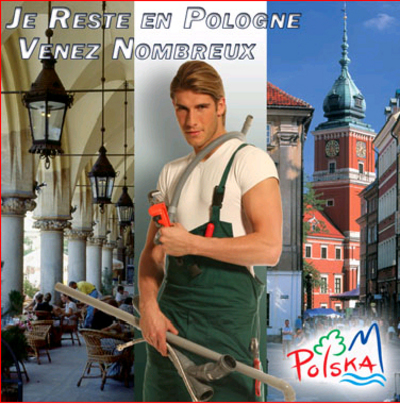
An article I wrote turns up in some weird and wonderful places.
The term the 'Polish plumber' was first used by French politician Philippe de Villiers (although this is disputed - see comment) to explain the fear that French voters felt about an expanded EU during the time of the referenda in May. I wrote an article about it called Polish plumber puts a spanner in the works.
Since then it has turned up in all sorts of places, such as freerepublic.com etc, UK Ratifiers for Democracy and even a blog with the title fuckfrance.com!
So it is with delight then that I learn that a political article such as that one about the EU has turned up in...Daily Plumbling News - a blog for plumbers!!!
Friday, September 09, 2005
The Chernobyl myth revisited

The United Nations has confirmed that fears of hundreds of thousands dead and dieing from the Chernobyl disaster in 1986 are unfounded.
As I pointed out in an article I wrote last January (see The solution for a cleaner environment: Go nuclear!) the reporting of the meltdown of the old No. 3 reactor in rural Ukraine nearly two decades ago continues to exaggerate what really happened there.
The United Nations report states that 56 emergency workers lost their lives in Chernobyl that day. Many more have gone on to develop cancers directly as a result of the accident. But these are all from the emergency services, not, as has been reported over and over again, from those living in, around, and far away from the reactor. Radiation did travel west and north of the town into Poland and Belarus, but nobody has died as a result.
But this has not stopped reporters from reputable organizations from repeating what has become another doomsday myth. For instance, the BBC in December 2000, when the reactor was finally shut down for good, stated that:
“Thirty-one people, mostly firemen, were killed immediately after the explosion, and several thousand more - those involved in the clean-up and children - have since died from radiation-related illnesses. Ukraine says the health of millions of its people have been affected by the disaster.” (see Chernobyl shut down for good)
The new UN report merely restates what an earlier report by the same organization (see United Nations Scientific Committee on the Effects of Atomic Radiation) stated in 2000. The deaths that occurred were to emergency staff and not the local population, and that many less have died and will die than was originally reported.
Well, they would, wouldn't they?
I was at a dinner party shortly after I wrote my original story nine months ago, and was talking about the Chernobyl myth. I was asked how I knew all this, and I said that I just read a report by the UN and talked to one of the scientists that worked on the report, Zbigniew Jaworowski. The disbelieving response was typical: “Well, the UN would say that, wouldn’t they. I bet they have a lot to hide.”
When I asked my dinner party friend what he thought the UN had to hide by ‘covering up’ what happened in the Ukraine many years ago, he couldn’t answer. Incapable of having a discussion about nuclear energy, he fell back on that old, limp tactic of ‘Well, they would say that, wouldn’t they.”
And of course you can’t discuss something with somebody who sees cover-ups and conspiracies everywhere – even though they have no evidence to back up the claims. Looking for motives for saying x has become more important than looking at, and confronting what x actually means. Consequently, nothing is debatable. Nothing can be argued to be right, or wrong. We live in a world where people (mostly scientists and politicians) only think and believe things because of some ulterior motive.
So debating politics (or anyting else for that matter) has become impossible with these sorts of people. Debating nuclear energy is now impossible with the techno-luddite and the NYMBY.
And this is a shame at a time when the EU, and the Kyoto agreement is telling us to cut our reliance on fossil fuels.
Wednesday, September 07, 2005
Presidential homophobe gets taken to human rights court

Lech Kaczynski, second in the opinion polls at the moment for the race for the presidential palace, is being taken to court for denying Polish gays rights to free assembly.
Kaczynski, who is also the mayor of Warsaw, refused permission for a gay and lesbian pride march through the center of Warsaw this May. This is the second year in the row that Kaczka has let his bigotry get in the way of his duty to citizens of the Polish capital.
Outraged, gays, lesbians and human rights campaigners went ahead and had the march anyway.
Now, gay and lesbian associations here have lodged a complaint with the Human Rights Tribunal in the Hague accusing the mayor of civil rights abuses.
The European declaration on human rights protects the civil rights of gays and lesbians.
Donald Tusk – fighting for the right to snort

If opinion polls are to be believed, presidential candidate, Donald Tusk, could well be the first member of an ethnic minority – and snuff taker – ever to set up residence in the Polish presidential palace.
When the government banned the sniffing of snuff in the nineteen nineties, Kashubians – the Slavic ethnic minority from the Pomeranian region in northwest Poland – were up in arms. Putting powdered tobacco up the nose has been an integral part of their culture since the seventeenth century.
At the head of the campaign for the right to sniff snuff was leader of Civic Platform, Donald Tusk. “If snuff is banned then we might as well ban smoking cigarettes,” he says. And in a country where millions puff, cough and wheeze their way through packets of ciggies everyday, this was not a political option.
So, in 1999, an amendment to the law on the protection against the effects of tobacco products re-legalized snuff taking. Thousands breathed (and sniffed) a sigh of relief.
Donald Tusk has been a tireless campaigner for the linguistic and cultural rights of Kashubians since he was at university. “The way to keeping the culture alive,” he says,” is for the authorities to give full recognition to Kashubian as a distinctive language, and not a dialect.”
He has published an elementary school textbook in the language, and a children’s dictionary. Because of his efforts, the language is now taught at schools in the region as a second language. “These days the language is really catching on; cultured Kashubs even like to show off by speaking it.”
It’s generally thought that there are around 300,000 Kashubs in Poland. However, in the last census in 2003, only 5,000 identified themselves as such, though 50,000 said that they could speak the language.
“The Polish and Kashubian identities live closely together. To be a Kashubian means to be Polish. Kashubs don’t like to think of themselves as a minority. They don’t even like the word ‘minority’. Where they live, they are the majority.”
The Kashubian region was incorporated into Poland in 1454. The area was invaded by the Teutonic Knights, the Swedes, the Brandenburgs and the Prussians. But as the soil in the region was not particularly fertile, and fishing unpredictable, Kashubians often suffered great poverty. Between 1859 and 1898 many thousands emigrated to Canada and the United States in search of a better living. Consequently, the Kashubian identity faded away.
Kashubs fight back
To make matters worse, being a member of an ethnic minority was not encouraged in communist Poland.
As a result, Tusk, born in Gdansk in 1957, was 21 years old before he knew he was a Kashubian.
“I was stunned when a colleague of mine at university told me of my ancestry. My parents, grandparents and great grandparents were born in Gdansk. The city was a real melting pot of German and Polish cultures. Kashubians who lived there quickly forgot their roots. My parents were totally unaware of their ethnic identity.“
Worse, belonging to that ethnic group had negative connotation. “Only a couple decades ago, the label ‘Kashubian’ was a term of abuse; it implied that you were a bit ‘simple’.
But the realization of his true ethnic identity quickly produced positive results. “When I was at university, one of my professors could have kicked me out of college because of bad grades. But, as he was a Kashubian too, he didn’t. This act of solidarity really meant something to me.”
Kashubian crafts specialize in embroidery, ceramics, painting on glass and amber jewelry. One of the crafts and traditions characteristic of the region is making snuff pots out of cow’s horn, made in the shape of a cone, sometimes with a top curved into the shape of animals or birds.
Don’t be surprised when in the area to be offered snuff. You might hear the phrase ‘Chceme le so zazec’ – Let’s take snuff.
Snuff sniffing is a habit usually associated with males and maleness. Refusing to take some between the crook of your thumb and forefinger is considered bad manners. Kashubians take their snuff seriously, and it is a core part of their cultural identity. Hence Donald Tusk’s fight to legalize the practice.
Could it be, then, that Poland is about to elect its first Kashubian, and snuff snorter into the presidential palace? Certainly he’s assured of much of Kashubian vote.
A version of this article first appeared in the NWE
Monday, September 05, 2005
Polish politics: confused? You ought to be

With a general election only weeks away, and a presidential election early next month, you will often be hearing descriptions of the various political parties as either being right, left, liberal, moderate and so on. But these labels in Poland can be very confusing. (pictured: Andrzej Lepper, Samoobrona)
Take, for example, the leading political party in most of the opinion polls at the moment, Civic Platform. I have seen them variously described as liberal, centrist, center/right, rightist, and even neo-conservative.
The term ‘liberal’ is doubly confusing as it means different things on different sides of the Atlantic. In the United States ‘liberal’ is generally seen as being left of center. To an American right-winger, a liberal is a ‘pinko’ who believes in Big Government. During the McCarthy trials in the nineteen fifties a liberal was a communist (although we should remember that having a significant amount of facial hair in nineteen fifties made you a communist in America).
In Europe, however, a liberal means someone who believes that the government should stay out of most areas of public and private life. To ‘liberalize’ the economy means to roll back state intervention. A liberal in Europe can mean a right-winger who believes in small government.
But what does a ‘neo-conservative’ mean? Does this mean Civic Platform is Poland’s first party of neo-cons? Does this mean that Civic Platform share the foreign policy ideology of a Paul Wolfewitz and Donald Rumsfeld, for example (and are they planning to invade Belerus)? And if they do share this view of the world, then how does that make Civic Platform ‘moderate-centrists?
If you actually take look at Civic Platform’s manifesto it basically consist of liberal (in the European meaning of the term) economic policies – meaning increasing the rate of privatization, and a low, flat tax policy – an idea attractive in many ex-communist countries. But on social issues the ‘liberal’ Civic Platform is relatively conservative – they do not propose to ‘liberalize’ Poland’s very restrictive abortion laws, for instance.
Liberal, free market economics, plus social conservatism are actually policies associated with Margaret Thatcher in her prime in the nineteen eighties. And if you called Maggie Thatcher a centrist-moderate, or even a center-rightist in those days she would have given you a sharp crack over the head with her handbag. Thatcher was a radical right-winger. Period.
Civic Platform, in the Polish context, is often called center-rightist or moderates, but in any other context they would be thought of as simply rightwing.
Confused yet? Well, it gets worse.
Take what have been called the ‘far-right’ League of Polish Families. These are ‘christian nationalists’, with a nationalist pedigree that goes back to the nineteen thirties. Historian Norman Davies has described The League of Polish Families nationalist, forbears as ‘professional anti-Semites.’ So they do sound like typical far-rightists in their choice of prejudices.
But when the League of Polish Families was set up as a political party a few years ago I saw them labeled as ‘christian left’ – whatever that means. For sure, their policies are based on an interpretation of Polish social Catholicism, are isolationists – they hate the EU, for example, as they think that Poland will become inundated with social liberals (in both the American and European meaning), abortionists and gays and lesbians. They also want to restrict the amount of foreign capital in Poland.
So are they left, or right?
The Law and Justice party was set up by the Kaczynski twins, Lech and Jaroslaw. They have been described as ‘conservative’, ‘right wing’, or even, sometimes, ‘center/right’. They have promised to be tough on crime and criminals, even going as far as to bring back the death penalty. These types of anti-crime policies are usually associated with the political right. Economically – and here’s the twist - Law and Justice are, if anything, to the left of the so-called ‘centrist’ Civic Platform, but to the right of the so-called ‘christian leftists’, the League of Polish Families.
Agrarian populism
Another grouping you will hear of in the coming few weeks is Samoobrona – or SelfDefence, led by the political bullyboy, Andrzej Lepper. This was set up as a kind of farmer’s trade union, protesting against all sorts of things, from liberalization and increased competition from agriculture outside of Poland, to attacks on farming subsidies, etc. At a loss to where to put this lot’s political orientation, journalists have turned to the catchall label of populist.
Populism – which can be either left or rightwing - usually refers to a rhetorical style that appeals to the ‘common sense’ of the electorate and the average man or woman in the street. It asserts that the political elite is corrupt and self-serving and needs to be overthrown by people with ‘common sense’. It also usually incorporates a bit of racism or nationalism thrown in for good measure.
This does describe SelfDefence quite well, but populism is also a label that could be applied to many of the political parties in Poland.
Except, that is, to the Social Democratic Left – a party that was formed out of the old Polish communist party. Policy wise these are basically social democrats, but they are the ones who are being accused of being the self-serving corrupt elite by the populist parties. Law and Justice and League of Polish Families pledge to purge the ex-communists, not just from government, but from the civil service, many other quasi-governmental organizations, the secret service, and so on.
Consequently, in Poland, how far a political party can be described as ‘rightwing’ really comes down to how much they hate the ex-communists.
At a time when left and right are all but loosing their meaning in the west, in Poland, where these labels are quite new to the political scene, they are all but useless. Politics in ex-communist countries is peculiar to ex-communist countries. So using the terminology of left, right, etc, has little meaning outside of the country where the terms are being used.
But journalists will still be using them. And if you think that you are confused by Polish politics, spare a thought for the poor old Polish voter who will have to choose where to put their tick beside a name of a party, or individual, that could labeled as either liberal, centrist, rightists, moderate, neo-conservative, or all of them simultaneously.
And people wonder why turnout in Poland is so low!
A shortened version of this article can be found at the Radio Polonia web site


